Wednesday, October 31, 2012

The Lucasfilm Announcement Stream-Of-Consciousness Reaction

Tuesday afternoon. Think I’ll check Twitter, see what’s going on.

Hey, look! Somebody tweeted that Disney acquired Lucasfilm! Ha ha! What a hilarious joke! Now other people are tweeting it, too. Hmm, I sure hope they realize it’s not true, otherwise a giant false rumor could get started.

Wait, one of the tweets has a link to a press release. A Disney press release.

Holy crap, it’s true! Disney acquired Lucasfilm. That means they own Star Wars. Disney owns Star Wars.

Disney. Owns. Star Wars.

Wow.

Well, I wonder what this means. Probably nothing. There’s already a Star Wars ride in the parks, after all. And they already sell Star Wars and Indiana Jones merchandise in the parks. Probably all this means is that Disney just gets a piece of all the money Lucasfilm makes. They’re not going to do anything major, I’m sure.

Hey, somebody tweeted that there’s going to be a Star Wars Episode 7 in 2015. Okay now, that’s just stupid. There’s no way that one’s true. In fact, let me read over the press release. There’s just no way Disney’s going to make another-

Sweet Mother of Optimus Prime, they are! They’re making Episode 7! What? WHAT?!

No. No no no no no NO NO! No. Uh-uh. Nyet. No more Star Wars movies! The prequels were bad enough! The last thing we need is more wooden acting, long conversations about politics, and racially insensitive CGI comic-relief Muppets! More of THAT please!

On the other hand, maybe it could be good. I mean, if Lucas isn’t directing, and the people involved are fans of Star Wars it could work. Right?

Holy Mr. T’s Mohawk, I can’t believe this. I must be having some kind of a fever dream. Did somebody spike my Pepsi with a hallucinogen?

Disney owns Star Wars.

There’s going to be more Star Wars movies.

Holy William Shatner’s Toupee.

Holy Wesley Crusher’s Rainbow Sweater.

Look, only 50 people have made the “I guess Leia is a Disney princess now” joke. And every one of them thought it was original and funny. Sometimes I think the Internet is making it where we all think alike. This is probably how the Borg Collective got started.

More Star Wars movies, wow. This was not what I expected when I got out of bed this morning.

Star Wars. Disney. Star Wars is Disney.

Holy Richard Simmons’ Afro.

Holy Superman’s-Red-Underpants-That-He-Doesn’t-Have-Anymore-In-The-New-52-Continuity.

Wow . . . .

Sunday, October 7, 2012

From The Seas to The Living Seas and Beyond

In 1981 visitors to Florida’s Magic Kingdom could stop by the EPCOT Center Preview Center on Main Street and get a preview of the new park by watching the 15-minute film “The Dream Called EPCOT”. For many people, that film was the first they ever heard of The Living Seas. Interestingly, although it described a Living Seas experience that was pretty much exactly what we got, other EPCOT promotional literature promised a much more elaborate adventure that was rooted in earlier concepts for the pavilion.

One of the earliest renderings of the Seas’ aquarium is this one:
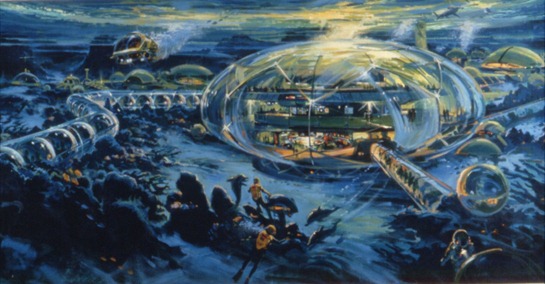
Seas_early_concept

It’s certainly a pretty picture, but it’s also a rather fanciful concept that would have been impossible to build with late-1970s technology and would likely prove daunting to 21st century engineers, as well.

A much more reasonable version of the Seas pavilion could be seen in WED’s EPCOT Center concept model from 1978:
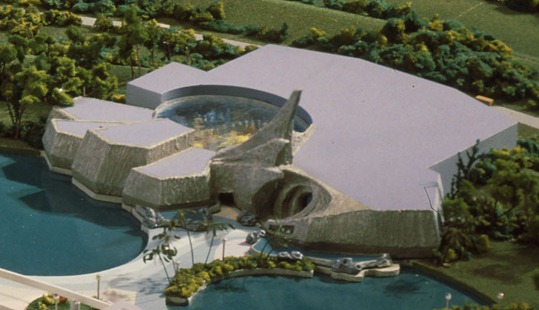
Seas_1978

Positioned in the Future World West plot now occupied by The Land, this version of the pavilion featured a rocky-looking exterior with a cavelike main entrance and a glass-roofed aquarium. This would seem to be an exterior view of this cutaway model seen in Richard Beard’s EPCOT Center book:
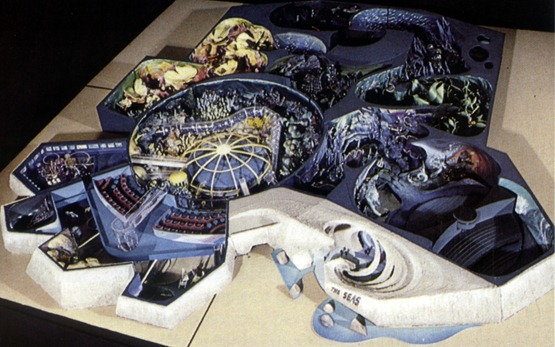
Seas_model_1970s

It was this version of the Seas pavilion that formed the basis for most official descriptions of the attraction contained therein. And since The Living Seas didn’t open until 1986, these descriptions hung out there for four years after EPCOT Center’s 1982 opening. In the process, they served to set a lot of incorrect expectations for what a visit to The Living Seas would be like.

Originally, The Seas was supposed to consist of three main experiences:

  1. A preshow hosted by Poseidon or perhaps Neptune, which led to:
  2. A dark ride in bubble-shaped Omnimovers through a number of set pieces and Animatronics depicting scenes of undersea wonder and peril, culminating in:
  3. The ride vehicles cruising into the pavilion’s massive aquarium through a clear tube leading to an observation area, where visitors would disembark to observe the aquarium and perhaps view educational exhibits.

And although the location and exterior configuration of the Seas changed several times, that basic attraction layout persisted. Another draft of EPCOT Center, likely dating from 1979, shows the Seas pavilion in the Future World East plot that Horizons would eventually occupy:
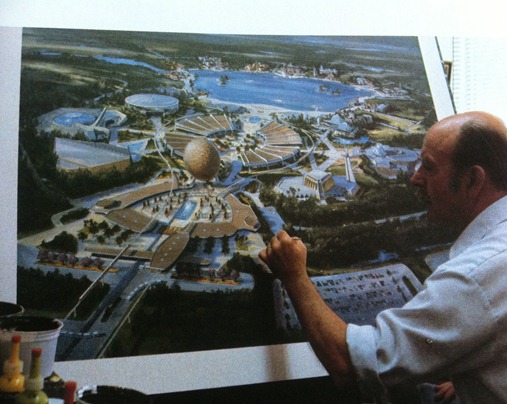
EPCOT_1979

In this rendering the building looks a little sleeker, and there’s now a blue dome over the aquarium.

By 1980 the Seas had been moved to its final location in Future World’s northwest corner. And it had received another facelift:

Seas_1980

This version of the Seas pavilion had a less organic appearance, and this time the aquarium was covered with a multifaceted golden dome, much like the one that later became Wonders of Life’s defining visual feature.

Giving the aquarium a transparent or semi-transparent roof was certainly visually attractive, but I wonder how practical it would have been. For one thing, it likely would have made it more difficult to control the water temperature. That’s critical because live coral can’t handle much temperature variation. And imagine the noise when the torrential downpour from a tropical storm or Florida afternoon thunderstorm struck that roof!

Finally, the EPCOT Center concept painting from 1981 shows what many people believe to be the final version of The Living Seas pavilion:

Seas_1981_rendering

But is it? Let’s compare this painting of the pavilion to an aerial photo:

Seas_aerial_photo

Notice how the northeast corner of the pavilion in the painting contains an angular extension that’s missing from the pavilion as constructed? Why is that? Well, according to Martin Smith’s Living Seas Ultimate Tribute video the final Seas concept to include the immersive dark ride was, on the outside, very similar to the pavilion we ended up getting. It was just a little bigger in the back to accommodate the ride. Therefore, it’s a good bet that the Living Seas pavilion we see in the 1981 painting is that version.

Of course, by the time that construction began on The Living Seas in 1984 (the year it was originally supposed to have opened) corporate sponsor United Technologies had refused to pay for the dark ride, and a scaled-down version of the pavilion was what began to take shape behind the construction wall. Nevertheless, the Coming Soon sign on the wall featured this concept painting:

SeabaseAlphaExterior

I love this picture. The bubble cars, the impossibly futuristic divers’ suits, and the Honda Civic-sized mini-sub tooling about, it’s great. But it has the same problem as the first piece of concept art we looked at: it depicts a saltwater tank that’s impossibly huge. I realize that this is more a piece of artwork than a technical diagram, but wow! The aquarium in the actual pavilion was the largest ever constructed at that time, but it’s a kiddie pool compared to this! Still, the mini-sub is extremely cool (even if it is too big for the actual aquarium at the Seas) and it’s a shame it didn’t make it to the final version of the pavilion because it definitely had merchandising opportunities, as this Seabase Alpha interior rendering shows:

 SeabaseAlphaInterior“In 2012 I’m gonna sell this thing for a million bucks on eBay!”

This next couple of concept paintings may very well date from the version of the pavilion that featured Seabase Alpha and the bubble-car dark ride. We get a glimpse of the Omnimover unload area here:

Seabase_Alpha_unload

. . and a scene from the ride itself here:

seas_bubble_carsIs it just me, or does the guy on the left look a lot like Lando Calrissian?

These renderings belong to the family of paintings I call “Smiling People Pointing At Things”. But as I mentioned previously, despite the Concept Art People’s happy pointing corporate sponsor United Technologies decided it didn’t want to pay for this awesome ride. So the bubble cars were turned into more garden-variety Omnimovers, and the dark ride was completely scrapped. Now, the SeaCabs would just convey visitors on a short trip past some aquarium windows and into Seabase Alpha.

The attraction flow of the Seas pavilion was therefore changed. Instead of the preshow/dark ride/Seabase combination that we’d been hearing about for four years, we got a preshow/Hydrolator/SeaCab/Seabase combination.

While they didn’t make up for the loss of the dark ride, the Hydrolators were a nice touch. Aside from the interior effects that simulated movement, the Imagineers even added “overflow pools” outside the Hydrolators that bubbled up as the Hydrolators reached the “surface”, as if their upward movement was displacing the water in the submerged elevator shaft.

SeaBase Alpha was impeccably detailed:

Seabase_Alpha

It really felt like an undersea research station you’d see in one of the Star Trek movies from the mid-80s. In fact, if you remove just a very few of the 20th century trappings, it would have served as an ideal filming locale for an episode of Star Trek: The Next Generation. I’m told that seaQuest DSV actually did film there, but I never watched seaQuest. In fact, the only thing I remember about it was that there was a talking dolphin and that kid from the ridiculous movie that gave birth to the Chuck Norris Facts meme.

The thing that doomed the Seas, in the end, was the modularity of its experiences. I’ll explain: the pavilion only worked if you experienced everything: the preshow film, the Hydrolators, the SeaCabs, and the Seabase. Each individual experience wasn’t terribly immersive, but they all added up to an experience that was nearly as immersive as the proposed dark ride would have been. But when United Technologies failed to renew their sponsorship, the Eisner-Pressler cost-cutting machine swung into operation and walled off the Seacabs. Because of the way the ride was designed, the unload area was just a scant few yards away from the load area, so it was nothing to simply block the whole thing off and funnel everyone from the Hydrolators directly into the Seabase. You could never do something like that to Spaceship Earth; the design of the building just won’t permit it. Just like that, a key piece of The Living Seas experience was gone, and the pavilion now felt incomplete. People began to stay away, maintenance cut back, and the pavilion gained the derisive nickname “The Dead Seas”. Eventually, The Living Seas was shuttered and slated for Pixarification.

I’ve always tried to maintain a balanced view of The Seas With Nemo And His Computer-Generated Friends. After all, since its facelift the Seabase area is absolutely teeming with little kids who are genuinely excited and curious about the marine life swimming around in the tank. However, the pavilion still suffers from United Technologies’ decision not to fund the elaborate dark ride. How? Well, thanks to the pavilion’s modularity (there’s that word again!) the Seacab ride was never demolished, just walled off. So when the Seas got its Nemo refurbishment, the Imagineers took the logical route and simply built a ride around the existing (very short) ride track. The preshow theaters and Hydrolators were ripped out and replaced with . . . an elaborately themed queue. And while it’s really nice-looking, you have to work a lot harder to suspend your disbelief and convince yourself that you’re “really” going beneath the sea.

If, back in the early ‘80s, United Technologies hadn’t been so stingy, we might still have The Seas With Nemo and Friends. But it would be a much more immersive and transportative experience than what we have today because the longer dark ride would still be there.

Well, I hope you’ve enjoyed this exhaustive, long, and rambling look at The Living Seas. If you did, then you absolutely must check out Martin Smith’s Ultimate Tribute To The Living Seas, which was where I got the majority of my information for this post. Also, I’d be remiss if I didn’t thank Progress City, USA’s (and D23’s) Michael Crawford for helping me get some of my facts straight.

Tuesday, October 2, 2012

Why EPCOT Center?

Well, EPCOT’s 30th anniversary celebration has come and gone. Sadly, I was not able to be there, which really killed me since the chance to be in the park with other people who appreciate it like I do probably won’t come again until the 40th anniversary in 2022. Still, thanks to Twitter I was able to keep abreast of the goings-on, and it certainly looked to be a weekend awash in EPCOT Center nostalgia.

If you’ve only ever experienced the present incarnation of the park, it can be hard to fathom why such nostalgia exists. Why do people get teary-eyed when they hear “One Little Spark” or “Tomorrow’s Child”? And what is with their insane devotion to Horizons, a ride that was torn down over a decade ago? It can be easy to draw the conclusion that we’re unable to let go of our childhoods and wish the park would remain forever frozen in the year 1989. But that’s not it at all.

EPCOT Center aimed not only to entertain, but also to inspire and educate. And it did an excellent job. For those of us who experienced the unique inspirational power of EPCOT Center as children, it profoundly affected us for the better. It left a positive imprint that’s stayed with us for the rest of our lives. And although most of us went through our snotty teenage phase where we considered things we’d enjoyed in our prepubescent years to be lame and uncool, when it was time to face the world as adults it was inevitable that we’d return to EPCOT looking for that same spark of inspiration. And boy, did we not find it.

It’s not that we expected EPCOT to never change. In fact, change was a big part of the original EPCOT Center experience. Especially in Future World, things were supposed to constantly change as the years went by and technology advanced. Of course, keeping what was essentially a giant-sized Tomorrowland on the cutting edge of technology was probably an impossible task, especially after the corporate sponsorships began to thin out. So some kind of re-focusing of Future World in a way that deemphasized technology was always inevitable. But as long as the park retained its focus on inspiration and education, I don’t think anyone would have had a problem with that.

Unfortunately, most of the changes made to EPCOT in the last eighteen years served to strip it of that inspirational quality. Also mostly gone is the experience of walking into a huge pavilion and experiencing a ride or show that transports you to another time and place. Most of the more recent EPCOT attractions seem to be designed to provide a certain minimum level of entertainment while funneling people into a gift shop, all while being cheap to operate.

So, when those of us who remember what EPCOT Center used to be say that we wish Horizons or World of Motion or Journey Into Imagination were still around, what we’re really saying is that we miss going to EPCOT to be inspired and transported to other places and times. That’s what made EPCOT Center so special. And that’s why we miss it so much.

Thursday, September 20, 2012

The EPCOT30 Discontinuity Overanalysis

Corporations with long histories like Disney are usually myopically focused on the present. While they’re more than happy to use past successes to promote themselves, their image of the past is always very much a hazy, soft-focus picture that completely omits any of the company’s mistakes or failures. The continuing narrative they present about themselves in their advertising is that, while the past was glorious, the company’s present set of offerings is the best it’s ever been, and that there’s no better time than now to give them a whole bunch of your money.

Disney’s occasional theme park anniversary celebrations are a prime example of this. You can expect an anniversary celebration at Florida’s Magic Kingdom, for example, to include lots of talk about how many generations of children the park has entertained and maybe even some clever nods to old attractions that wouldn’t appeal to modern audiences, like If You Had Wings or The Mickey Mouse Revue. But there will usually be no acknowledgement of offerings like the Mike Fink Keel Boats that were removed just to cut costs, because that would be too much like admitting a mistake. And if there’s one thing that large corporations and third world dictatorships have in common, it’s an aggressive whitewashing of the past to eliminate anything that has the slightest potential to be unflattering.

Disney has been doing this for a long time. Heck, they spent most of the 1980s insisting that the Walt Disney World Resort was the Experimental Prototype Community of Tomorrow that Walt wanted to build in Florida, and that EPCOT Center was built exactly according to Walt’s vision. The trend has only accelerated since they became a multinational corporate behemoth, and it presents a special problem for EPCOT.

By any objective standard of measurement, EPCOT was way better before 1994. It offered more and higher-quality attractions, better food, and better shops with a greater variety of merchandise. More than any other property in the Disney empire, EPCOT has been diminished by eighteen years of mismanagement and a cynical philosophy that says it’s okay to save money by eliminating nice things because customers are too stupid to know the difference between filet mignon and a dirt sandwich.

Which is why the distinct EPCOT Center flavor of EPCOT’s 30th anniversary celebration is so surprising. Take a look at this piece of official artwork:

EPCOT30

Notice anything strange about it? There’s nothing of present-day EPCOT there. It’s the same story with the anniversary merchandise; except for the execrable sight of Duffy in a Figment sweater and a strange-looking Mickey Vinylmation, all the 30th anniversary items are EPCOT Center-related. And from the information that’s been released, it appears that the special anniversary events focus entirely on pre-1994 EPCOT Center. Most of these theme park anniversaries focus on the present and ignore the past; this one is essentially ignoring the present. It’s certainly tempting to look at all this and see it as a tacit admission by Disney that they’ve botched the last eighteen years.

As I often say around here, I’m not a Disney insider, just a guy with opinions. But I read stuff written by people who do have inside information, and they’re all unanimous in pointing out how mistaken it is to attribute a singular corporate intent to everything that happens under the Disney umbrella. What we outsiders often think of as one monolithic Disney Corporation is actually a huge sprawling thing full of numerous competing factions and fiefdoms.

My own uninformed opinion is that the EPCOT30 celebration is the work of a pro-EPCOT Center faction. The fact that they seemingly are being left alone to do what they want (as long as they stay under budget, I imagine) suggests to me that they really aren’t on the executives’ radar. It’s kind of like how the creative staff of Deep Space Nine was able to get away with taking all kinds of interesting risks because the Paramount executives were ignoring them to focus on Star Trek: Voyager and the film franchise. So I’m certainly not taking this year’s EPCOT Center lovefest as a sign that Disney’s executive decision-makers have decided to start investing the money to reverse all their EPCOT-related mistakes of the past two decades.

But I’m hopeful that the EPCOT30 celebration brings in a ton of money and gives the pro-EPCOT faction within the company some more ammo to make the case for a little more reinvestment in what was once the crown jewel of theme parks.

Saturday, September 8, 2012

The EPCOT Logo Futurization Flub

The original EPCOT Center logo was great; futuristic and memorable:

epcotlogo

However, that didn’t mean it should never change. After all, EPCOT itself was supposed to constantly change, always adding new things and updating existing ones. So Disney’s decision in the mid-1990s to change the park’s logo was not necessarily a bad one. Unfortunately, the mid-1990s were not a good time for visual design. This was, after all, the period where Batman’s costume acquired rubber nipples and the NBA’s Toronto Raptors played in ridiculous-looking uniforms with jagged pinstripes and a cartoon dinosaur in the center of the chest. So maybe it was inevitable that EPCOT’s new logo would be bad. But at least the person who designed the nippled Batsuit was trying. Whoever designed the current EPCOT logo . . . well, just look at it:

Epcot_logo_present

It looks like something a clueless management trainee came up with in 1995 about five minutes after they discovered the Microsoft Works clip art gallery. It’s not just a bad design, it’s a lazy design. At best, it inspired indifference. I’m not privy to Disney’s sales figures, but I can’t imagine that merchandise featuring the present logo was ever a big hit. And these days, you can hardly find it. Almost all the EPCOT t-shirts on sale in the park are of the retro variety, which to me is a tacit admission that the current logo is less popular than the Tonight Show with Jay Leno. Last week on Twitter I said I could come up with a better logo just by typing the acronym “EPCOT” in an appropriately futuristic font. So I went to dafont.com, loaded up on some fonts from their Techno section, and came up with these alternate EPCOT logos:

vandiana-platin

Font: Vandiana Platin. I like this one because it’s basically a sleeker version of the typeface used in the original EPCOT logo. Even better, the park’s signage could also be rendered in this font (or a slightly narrower variant) and it would still be readable.

excelerate

Font: Excelerate. We have to keep in mind that EPCOT’s logo was updated in the 90s, and the predominant design sensibility then was less about making things sleek and minimal and more about making them look “kewl”. Although this one isn’t my favorite by any means, I think it’s something that could realistically have come out of that decade.

phatboy_slim

Font: Phatboy Slim. Another generically techno-looking typeface.

metro-df

Font: Metro-DF. The more I look at this one, the more I like it. I think one thing the designer/clip art selector of the present EPCOT logo was trying to do was represent the World Showcase and Future World in one design. This one does a good job of accomplishing that, I think, because it’s a little less futuristic than the other fonts we’ve seen so far.

prototype

Font: Prototype (the freeware equivalent of World Bold) Or they could have just rendered the “new” EPCOT logo in the font that’s been used on most of the Entrance Plaza and Future World signage since 1982. Even after all these years, it still looks pretty good.

And there you have it: five better-looking alternatives to the present EPCOT logo, created by simply typing the acronym “EPCOT” in a better font. Hopefully one day soon the current design will go the way of the Astuter Computer Revue, and a 21st-century version of the original logo will take its place.

Thursday, September 6, 2012

The Reality Rule

Last week when the five-year-old Cars Land-in-Florida rumor was resurrected by the Great Internet Speculatron, I got to thinking about the nature of reality.

I realize that sentence may raise some questions, like what does Cars Land have to do with the nature of reality? Also, what kind of chemicals are in the water where I am? So let me explain. For the last few years those of us who care about such things had resigned ourselves to the fact that there would be no Cars Land in Florida anytime soon, if ever, and that Disney’s Hollywood Studios would remain pretty much the same for the foreseeable future.

And then somebody on a message board who is generally believed to have inside information said that Disney was bringing Cars Land to Hollywood Studios. Some people loved the idea and some hated it, but for both groups Cars Land at the Studios was real. They were already picturing themselves walking down the Streets of America and seeing off in the distance a Radiator Springs Racers sign and those angled rocks from where Captain Kirk fought the Gorn.

KirkGornThe only difference is that the Cars Land rocks are more orange


And as things began to cool down with more rumors that maybe John Lasseter was against the idea and the realization that Disney’s thick-headed Orlando executives would rather surgically remove their own spleens than spend money on anything that’s not a DVC resort, plus the simple fact that even if Cars Land was approved it’d be several years before it opened, the orangey-colored rocks and Route 66 trappings began to fade from our mental picture of the end of the Streets of America. The Lights, Motors, Action stadium stood there again, just as it always had in reality.

This whole thing reminds me of the early years of EPCOT Center, and the excitement surrounding the World Showcase's most prominent "coming attraction", the Equatorial Africa pavilion. The definitive EPCOT Center tome, Richard Beard’s Walt Disney’s EPCOT: Creating The New World of Tomorrow, devoted a whole chapter to it, with a fairly detailed breakdown of the shows and experiences the pavilion would offer. Equatorial Africa was prominently featured as a coming EPCOT attraction in the park’s early years. Alex Haley even appeared on the EPCOT Center opening-day TV special in 1982 to talk about it, and his segment ended with him and Danny Kaye promising to visit the new pavilion together.

My point is that for a couple years there in the early 1980s, the Equatorial Africa pavilion was real. Buildings had been designed, shows had been written, concept art had been widely released, and there was a big sign on the expansion plot between China and Germany promising that Equatorial Africa was coming soon. How many people stopped and imagined that, on their next trip to Florida, the African pavilion would occupy that empty space?  And you can be sure that if today’s Internet had existed then, there would have been long debates about the new pavilion: whether it had too many attractions or not enough attractions or whether there should be a Mount Kilimanjaro coaster or flume ride to give the area some thrills. But all of those announcements, promises, imaginings and pieces of concept art were rendered moot when Equatorial Africa was cancelled and we were forced to face the fact that it was never real at all.

Over the years, Disney has announced a lot more projects that never advanced past the concept art stage: things like WESTCot, Port Disney, and Disney’s America. Other projects were drastically scaled down: only half the original Animal Kingdom concept actually got built, and the sweeping Project Gemini that would have remade EPCOT’s Future World ended up consisting solely of Soarin’. Perhaps you think this would make Disney fans adopt a “wait and see” attitude about any new rumors or announcements.

Don’t be silly.

The truth is that almost anything, be it an unsubstantiated rumor from someone who claims to have connections or a piece of concept art released on the official Disney Parks blog, is enough to whip the Disney fanbase into a frenzy of fiercely opposing viewpoints. Take Avatar Land, which is slated to open at Animal Kingdom at some point in the current century, unless it doesn’t. All that was announced was that there would be an Avatar Land at Animal Kingdom. That’s all. No concept art, no description of possible attractions, nothing. But that complete lack of data didn’t stop people from taking to the Internet to declare that Avatar Land would either be the best thing since penicillin or the worst thing since Rob Schneider’s career, and accuse the people who disagreed with them as being no better than the cowards who stood by and let Hitler overrun Czechoslovakia.

Now, the Disney fan community isn’t the only one that engages in this ridiculous behavior pattern. Right now there’s a segment of the online Superman fan community who has already decided that it hates the new movie Man of Steel, even though they haven’t seen it yet because it won’t be released until Summer 2013.

So, I’ve made a decision. By the power vested in me as a person who says things on the Internet, I hereby declare Kiri-kin-tha’s First Law of Metaphysics to be in effect online:

Nothing unreal exists, and no arguments about nonexistent things are allowed.

So, a Florida Cars Land? It doesn’t exist right now. It’s not real. So stop arguing about it. Avatar Land? It’s even less real than the Floridian Cars Land. No arguing about that either. If either of these projects actually gets off the ground and are actually built and opened, then they will be real and you can argue about them.

Okay, I’m going to get off my soapbox now. Later I’ll be back with a post about EPCOT’s logo, and as the 25th anniversary of Star Trek: The Next Generation gets closer I’ll have something about that.

Happy Internetting!