Thursday, September 26, 2013

The Coulson Resurrection Misdirect

So I saw the Agents of S.H.I.E.L.D. premiere the other night, and this is probably the only thing I will ever write about the show. Not because I didn’t enjoy it, on the contrary it’s a lot of fun. It’s just that this isn’t really a TV/pop culture blog. However, I really wanted to touch on a very common “writer’s trick” that the folks behind Agents of S.H.I.E.L.D. pulled, seemingly without a lot of the Internet realizing what they did. And yes, I should probably warn you that the following contains mild spoilers for the show, but honestly if you’re trying to avoid spoilers for a highly-anticipated piece of entertainment that’s premiered already, then you should probably just stay off the Internet.

The big question surrounding the show is how come Agent Coulson is in it, when the character was clearly killed off in that little movie you may have heard of if you were living on planet Earth at any point during 2012. Early in the show, Coulson explains that Loki didn’t stab him hard enough to kill him, and he got medical help in time, and then he took a vacation in Tahiti. But once Coulson leaves the room two other characters have a conversation in which it’s made clear that the Tahiti vacation was just a fiction, and Coulson “can never know” whatever the truth is. This moment is specifically designed to make you think that the show’s writers are keeping a secret, and you must continue to watch the show to find out what it is. And I guess I can understand why you’d fall for it.

If you’re twelve years old.

Everyone else should have a good enough sense of pattern recognition to recognize when the writers of a show are just trying to get us to keep tuning in. Remember Star Wars? When the original trilogy was being made, George Lucas would talk like there was some kind of big overarching story that he’d made up in advance, when in fact he was pretty much making things up as he went along. Or what about Ron Moore’s Battlestar Galactica from the 2000s? That show had all kind of mysteries from the very beginning, like the nature of Baltar’s “Head Six” or the meaning of the Opera House dream. And everyone was just sure that the show’s writers had all of this stuff figured out in advance, only to discover that they really didn’t, and they’d set it all up with no idea how they were going to pay it off. I never watched Lost, but I understand its creators did basically the same thing.

I’m not telling you not to watch Agents of S.H.I.E.L.D. Just know that the reason Coulson is alive is because the powers that be needed someone from the Marvel cinematic universe to be a regular in the show, and Clark Gregg is easier to get than Samuel L. Jackson. Enjoy the show, but don’t scrutinize every episode for clues on the secret of Coulson’s resurrection, because there aren’t any.

Sunday, August 18, 2013

The Star Trek Movie Ranking

At a recent Star Trek convention in Las Vegas-which was held during the same weekend as the D23 Expo-the crowd was polled about their favorite Star Trek films, and the result was the films being ranked in the following order:

STfilmrank

Obviously this ranking of the films is totally incorrect, meaning that I have a different opinion. Also, what the heck is Galaxy Quest doing there? It’s a fun movie, sure, but it’s not a Star Trek film any more than Spaceballs is a Star Wars film. Anyway, here is my listing of the Star Trek films, ranked from worst to best. All films are ranked solely on the basis of how much I enjoy them, and nothing else. Your mileage may vary. Let’s begin:

12. Star Trek: Nemesis. Nemesis is a terrible movie that fails on pretty much every level. Check out the Plinkett review if you’d like a detailed breakdown of all the film’s problems, but here are the most outstanding ones: a horrible script that tries to trick you into thinking it has a complex mystery plot when it’s really just a cynical rehash of The Wrath of Khan, a tired “nature-versus-nuture” message that’s only profound if you’re age 12 or younger, and production values that are more suited to a SyFy original movie than a major motion picture.

11. Star Trek: Insurrection. A bland, forgettable excuse for a film. The only reason it exists is because it had been two years since the last one, and at the time two years was the prescribed interval between Star Trek movies. Insurrection tries to be too many different things, and it fails at all of them. It wants to be an action movie like First Contact, and fails because its company of middle-aged TV actors are not convincing action stars. It wants to be a romantic comedy, but the humor is forced and unfunny and the romance between Picard and Anij isn’t believable. And it also wants to be a Classic Star Trek Morality Play, but it fails at that too because the moral is stupid: the 600 attractive Space Amish who aren’t native to the planet should get to hoard its Fountain-of-Youth powers for themselves for what reason exactly? In the end, the only good thing you can say about Insurrection is that it’s not quite as bad as Nemesis.

10. Star Trek: Generations. Generations is a textbook case of what happens when there are too many cooks in the kitchen. Paramount wanted the film-which was supposed to reboot the film franchise with the Next Generation cast-to include some cast members from the Original Series. Originally it was supposed to be all of them, but when that proved impossible it was whittled down to William Shatner and whoever else was available and didn’t want too much money. Picard and Kirk were supposed to meet somehow, but without time travel. Also, Patrick Stewart wanted an emotional storyline for Captain Picard. And William Shatner wanted to be able to ride his horse. The producers wanted Data in a central role since he was the Next Generation’s most popular character. And of course there had to be action and space battles. Oh, and all of this had to happen on about half the budget that a normal blockbuster tentpole film would get, because Paramount was kind of cheap when it came to Star Trek. Brannon Braga and Ronald D. Moore-who had only written for television before this-put all these required elements into a blender and the result was a movie where the climax is three elderly dudes having a fistfight on top of a mountain. The one positive thing I’ll say is that the saucer crash sequence-which was one of the last big movie effects sequences to be accomplished without CGI-still looks pretty impressive after all these years.

9. Star Trek V: The Final Frontier. A trifecta of unfortunate events conspired to make Star Trek V a stinker: a writers’ strike, the fact that Industrial Light and Magic’s “A-team” was working on Indiana Jones and the Last Crusade and Paramount was unwilling to pay big bucks for ILM’s “B-team”, and the choice of William Shatner to direct. Shatner was fixated on a story where the Enterprise crew sets out to physically locate God. Producer Harve Bennett and co-star Leonard Nimoy tried to get him to reconsider, but Shatner was irrationally confident in his ability to make the concept work. Even worse, somebody (probably the studio, but I’m not sure) wanted the movie to feature the same kind of humor that worked so well in the previous film. Unfortunately, under Shatner’s direction the humor was mostly embarrassing slapstick that reduced the supporting characters to cartoon versions of themselves. With an experienced director, a more polished script, and better special effects, the movie might have been good. As it is, there are some nice moments, but not near enough to save it.

8. Star Trek: First Contact. I know what you’re thinking: how could I rate this one so low? First Contact is widely regarded as the best of the Next Generation films. I’ll admit that I loved First Contact when I first saw it. At the time it was a breath of fresh air for the franchise: reimagined Borg! Action hero Picard, armed with a big ol’ phaser rifle and an attitude! A new Enterprise designed for interstellar butt-kicking! Unfortunately, none of this makes up for the fact that the plot doesn’t make any sense and ruins the Borg, perhaps the most unique adversary we ever saw on Star Trek.

As originally conceived, the Borg were an impersonal horde of cyborg “space locusts”. Their only goal was the single-minded consumption of technology. (For their second appearance, it was decided that they also wanted to assimilate people) But it’s kind of hard for Captain Picard to have a verbal confrontation with an impersonal foe, and it must have been written into Patrick Stewart’s contract that every film had to have a scene with him verbally confronting the villain. And so the Borg Queen was created. As a concept, it was kind of cool-a physical manifestation of the Borg hive mind. Unfortunately, it also gave the Borg an Evil Leader. Instead of an impersonal, cybernetic locust swarm, the Borg were turned into a bunch of stormtrooper-like henchmen commanded by an Evil Overlord who brought about her own downfall by making all the stupid Evil Overlord mistakes.

First Contact’s B-plot, about Zefram Cochrane building his warp ship, is even worse. The movie asks us to believe that some guy living in a remote village in Montana in the aftermath of a nuclear war is able to build a warp-capable rocket ship out of spare parts. Not even Tony Stark could do that!

And just to strain the audience’s credulity even more, we’re asked to believe that these people who have been through a nuclear war and are still distrustful of each other and divided by deep-seated issues that go back centuries if not millennia, are suddenly inspired to join hands and sing Kumbayah by a UFO landing, then invite the aliens from the UFO to the local honky-tonk to have a beer with them. Do I even have to make fun of this?

All in all, Star Trek: First Contact may have accomplished what it set out to do in 1996, but I believe it’s aged worse than any of the “good” films in the franchise.

7. Star Trek Into Darkness. The most recent entry in the Star Trek film franchise is a fun and exciting ride. Unfortunately, like Star Trek: Nemesis it rips off The Wrath of Khan, albeit a bit more capably. But what really eats at me is how obviously unqualified Kirk is for his job. Prime Universe Kirk was always keenly aware of his responsibility for the lives of his crew. But JJ-verse Kirk doesn’t figure that out until about two seconds before his bad decision-making is about to get his crew killed by Admiral Robocop and his Big Bad Spaceship of Cartoonishly Obvious Villainy. This is clearly something that scriptwriters Robert Orci, Alex Kurtzman, and Damon Lindelof didn’t think about and would prefer the audience not think about, either. Still, setting that to one side (and it’s not easy!) I do like how this is the first Star Trek film since 1991 to even attempt some relevant social commentary. Also, the film is very well-acted, and all the actors give very enjoyable performances.

6. Star Trek (2009). For the first time since 1979, Star Trek got an actual movie-sized budget. And for the first time ever, the big-screen starship Enterprise was not crewed by middle-aged television actors. The result was a fun, fast-moving film that made Star Trek relevant again. What makes the success of this film even more remarkable was how similar it was to the previous film, Nemesis, which is the standard by which Star Trek movie badness is judged. Like Nemesis, it features a bald, irrationally angry Romulan-oriented person in a Big Evil Spaceship of Doom who plans to use his implausible superweapon to destroy the planet Earth to satisfy his vendetta against a member of the Enterprise crew. And although Nero’s reasons for wanting to destroy Earth make no more sense than Shinzon’s, J.J. Abrams Star Trek is still many orders of magnitude more entertaining. It’s just a well-executed film. The actors really shine in their roles; Zachary Quinto is especially good as Spock, and Chris Pine manages to make you root for Kirk even though he spends most of the movie behaving like an arrogant frat boy.

Unfortunately, the nonsensical decision to “award” Kirk with command of the Enterprise at the end of the movie despite the fact that he’s only just graduated from the Academy makes it very hard for you to suspend your disbelief. It’s bad enough that the film seems totally ignorant of the distances between things in the solar system (the Enterprise needing to “hide” behind one of Saturn’s moons to avoid being seen by Nero’s ship in Earth orbit reflects a level of scientific ignorance I haven’t seen since the old Lost In Space) but it kills me that it’s also ignorant of how real human organizations work, too.

5. Star Trek: The Motion Picture. I know everyone says this movie is boring, and they’re not altogether wrong. But The Motion Picture is by no means a bad film. It’s really amazing that it turned out as well as it did considering its troubled production history. It handles the characters very well; Kirk takes a while to get his groove back after being stuck behind a desk for two years and Spock has a great arc where he’s forced to admit that logic alone is not enough. Sure, the film focuses on Decker and Ilia to the exclusion of series regulars like Scotty, Uhura, or Sulu, but wasn’t the Original Series always doing the same thing? The big-screen Enterprise has never looked better than it did in this movie, and the ship’s interiors were thoughtfully designed by people who were honestly trying to depict what a futuristic deep-space exploratory vessel would really be like. Even the much-ridiculed “disco pajama” uniforms are thoughtful projections of what 23rd century astronauts might actually wear. The Motion Picture may not have as much heart as I’d like, but it certainly has a brain.

4. Star Trek VI: The Undiscovered Country. One of the very best. Director Nicholas Meyer (who also co-wrote the script) delivered a taut political thriller that expertly drew on current events of the time-the breakup of the Soviet Union and the end of the Cold War. Even better, he did it on a ridiculously tight schedule and an even tighter budget. Composer Cliff Eidelman’s score has a cool “eastern-bloc” sound that’s never really been heard on Star Trek before or since. Other things I like about the film: Admiral Cartwright, a character introduced in Star Trek IV, appears again in a nice bit of continuity then turns out to be one of the bad guys. Also, the behind-the-scenes folks did a excellent job redressing the sets to give the Enterprise a great submarine vibe. It’s unfortunate they didn’t get more time and money to more fully redress the sets they had to share with The Next Generation, most notably Engineering, but they did a fantastic job with what they had. Christopher Plummer is a wonderfully theatrical villain, Michael Dorn has a nice turn as Worf’s grandfather, and Kurtwood Smith does a good job as the Federation President. It’s a shame they couldn’t get Kirstie Alley to reprise the role of Saavik, as her betrayal would’ve packed more punch than that of brand-new character Valeris.

3. Star Trek III: The Search For Spock. Again, I’m ranking the films here based solely on how much I enjoy them. And since my favorite Star Trek films are the “Spock trilogy”, this film is in the right spot on the list. The Search For Spock is often tagged as a “bad” film by people who buy into the notion that only the even-numbered films are any good, but before Internet fandom started telling everyone how to think Star Trek III was pretty well-regarded. And why not? Sure, it’s not as good as Star Trek II, but that’s no reason to dislike it. It deals very well with the aftermath of Spock’s death in the previous film and I really love the story of our family of characters coming together and sacrificing their careers to save their friend. The Search for Spock also holds a special place in my heart as the first Star Trek film I ever saw. Christopher Lloyd does a fine job as the Klingon villain Kruge and Mark Lenard has a nice turn as Spock’s father Sarek, a role he originated on the TV series.

2. Star Trek II: The Wrath of Khan. What? How could I not rank this one number one? The Wrath of Khan is the best Star Trek ever! Have I lost my mind? Not at all. I really love The Wrath of Khan, but I enjoy the number one film on this list just a teeny bit more. And so, my number one favorite Star Trek movie is:

1. Star Trek IV: The Voyage Home. This is a fun movie, pure and simple. All the characters get something interesting to do (well, Uhura gets the short end of the stick there, but it’s hard to juggle seven main characters and one guest star in a two-hour film) the humor is genuinely funny and not at all forced, and we get to spend some time in every EPCOT Center fan’s favorite decade, the 1980s! Interestingly, The Voyage Home came out in 1986, the same year that The Living Seas pavilion opened, a nice piece of totally unintended Star Trek-EPCOT Center synergy. Walking around SeaBase Alpha, it was easy to imagine it as the futuristic undersea research lab where Dr. Gillian Taylor and her new 23rd century colleagues were studying George and Gracie.

Well, there you have it: my personal list of the Star Trek films, from worst to best.

Wednesday, August 14, 2013

The Pixie Dust Detoxification Effect

A warning: A lot of what I’m about to say will in this post come across as uncharacteristically blunt. I’m not one of those people who goes around telling anyone with a different opinion than me that I’m right and they’re wrong. In fact, I usually edit myself pretty strongly to avoid seeming hypercritical or not respectful enough of someone else’s opinions. So if anything I’ve written here makes you a little hot under the collar, I'm really sorry. But it's a very big Internet, and it's easy to filter out people who say stuff you don't like. And in the end, I'm just some guy. My opinions don't actually matter.

So let’s dive right in.

If you’re reading this I’m going to assume you’re familiar with the basics of MyMagic+ by now. If not there’s a pretty good breakdown here, although it does have an unreasonably positive spin in my opinion. I don’t like MyMagic+, and I think that anyone who looks at what it’s supposed to do and says that it makes the Disney World experience “better for everyone” is either a liar or a fool. I usually try to make more nuanced statements than that, but this not one of those things that’s just a matter of opinion. With MyMagic+, Disney is instituting a program that’s good for them and bad for their customers. There’s no way to completely opt out of the program since all ticket media will be RFID-enabled (more on that later) and those who choose not to use features like FastPass+ will have a much worse experience in the parks than those who do. These are facts. Not opinions. Facts. Let me break it down for you:

FASTPASS+

The current FastPass system will completely go away and be replaced by FastPass+. FastPass+ will encompass all attractions, not just the most popular ones, and will also include things like special parade and fireworks viewing areas and selected character meet-and-greets. All customers will get 3 FastPasses per day to be used at one park only. Also, all FastPasses must be scheduled in advance via the MyMagic+ mobile app or the My Disney Experience website. There will be little, if any provision for same-day FastPass availability. None of what I’ve just said is opinion or speculation, it’s all been confirmed by Disney. After reading that you can probably tell why FastPass+ is such bad deal for Walt Disney World visitors, but just in case you’re scratching your head and saying “That doesn’t sound bad at all!” let me explain why you’re wrong:

1. You will have to plan your entire vacation almost down to the minute. The complexity of a Disney World vacation had already reached the upper limit of what I was prepared to tolerate. Thanks to the Dining Plan, you have to make dining reservations months in advance unless you want to eat fast food your whole trip. Then, when you arrive at the park, you have to make sure the return times for any FastPasses you get don’t conflict with your restaurant reservations. It’s a hassle.

But now with MyMagic+, you’ll have to plan all this stuff out in advance. Instead of just saying “I think we’ll go to EPCOT on Tuesday”, you have to plan exactly what everyone in your party will do in EPCOT on Tuesday. You have to make sure that none of their FastPass return windows conflict with the lunch reservation you made for the family at Biergarten or your dinner reservation at Garden Grille. And what if your son Justin used his three FastPasses on Soarin’, Test Track, and Mission:Space and now he has no FastPasses left to get into the Illuminations viewing area with the rest of the family? Sure, he can go into the app and change it, but what if he doesn’t want to? Now you’ve got an argument on your hands, which distracts you from the spreadsheet you’re building to keep track of where everyone will be in the park at what time to make sure they don’t miss your meal reservations. And all that’s just for one day! Multiply it by a four day vacation and you can see what a gigantic pain in the butt this is going to be.

But wait! There’s more! You know how if you want to eat at an extremely popular restaurant like Le Cellier or Be Our Guest you have to make your reservation at literally the earliest possible second or you won’t get one at all? (Let’s suspend our disbelief here for a moment and pretend there’s a high demand for these restaurants because they serve genuinely excellent food, not because they’ve been unreasonably hyped by bloggers who are just trying to show off how totally part of the “knowledgeable Disney insider” crowd they are.) Now FastPasses are going to work the same way! If you don’t book your FastPasses for Soarin’, Toy Story Midway Mania, Space Mountain, or whatever insanely popular attraction you care to name at the earliest possible moment, you may not get one. And if you do, it could be at a ridiculously inconvenient time. Ask yourself how many average, non-theme-park-savvy people are going to realize this? How many of them will forget to book FastPasses altogether, or wait until the week before their trip?  I’d say the appropriate metaphor for those folks involves a river of excrement and a Native American water vessel without any means of propulsion. But, even if you’re the biggest Disney nerd there is and know exactly how to work the MyMagic system, you still won’t be able to avoid . . .

2. Longer wait times for everything. The current FastPass system doesn’t actually make wait times shorter. What it does is grotesquely inflate the wait time for standby riders while FastPass riders wait about as long as they would if there were no such thing as FastPass. This means that for highly popular but slow-loading attractions like Peter Pan’s Flight or Soarin’, the standby line is so long that it basically isn’t worth it to ride them without a FastPass. Of course, there’s a way around this: simply ride these attractions first thing after rope drop, before FastPass return times kick in. Also, it’s worth noting that attractions that load quickly, like the PeopleMover or Pirates of the Caribbean, don’t use FastPass, and their original loading procedure remains highly efficient.

But now this is all going to change. Since every attraction will have FastPass+, standby wait times for every attraction will be drastically inflated. And since you only get three FastPasses per day, you will end up waiting in some of those lines if you want to visit more than three attractions. Since FastPasses will be entirely reserved in advance, there won’t be a “window” at the beginning of the day where you can hop in the Standby line for a popular attraction and progress quickly through it without being held up by the FastPass process. The fact that wait times will increase is something even Disney acknowledges. Why else would they be installing interactive games in so many standby queues? Because they love their customers and want them to be happy? Or because of the need to placate customers who are going to be spending a lot more time standing in basically stationary standby lines once MyMagic+ is fully up and running?

3. Less flexibility. One thing Disney representatives always say when talking about MyMagic+ is that it’s all about giving their customers more choices, more options, more freedom to personalize their vacation. This is a completely and utterly false lie. It’s the same kind of thing that AT&T or Verizon says whenever they introduce some complicated new rate plan designed to squeeze more money from their customers but not improve their service in any way. What is really more likely, that a huge corporation like Disney or AT&T loves its customers so much that it wants to spend a huge amount of money developing a system to make their lives easier, then add it to the service it already provides at no additional cost? Or that they’ve found a way to enhance their revenue in a way that worsens their customers’ experience, and they’re just marketing it as in improvement?
FastPass+ will restrict you to one park per day. This is by design. Its stated goal, as outlined in company documents that have leaked online and/or message board postings from people with a proven track record for providing reliable inside information, is to solve the problem of outsized crowds at the Magic Kingdom (and EPCOT, to a much lesser extent) in the late afternoon and evening due to people park-hopping there after spending the first part of the day at Hollywood Studios or Animal Kingdom. What Disney would like is for people who started their day at Hollywood Studios to remain there, and presumably for people who started their day at Animal Kingdom to go back to their hotel room and sit on their hands, since that park closes at like 5 o’clock in the afternoon.

Now, to any sane person the answer to the question of how to get people to stay longer at Hollywood Studios, Animal Kingdom, or even EPCOT is obvious: add more attractions and entertainment to those parks that people will want to experience. After all, it worked pretty well in Anaheim with the California Adventure overhaul. But Disney is not in the theme park business just so it can do what people want, even if those people happen to be paying customers. No, the approach Disney is taking here is to herd people where it wants them to go, not where they are naturally inclined to be. The executives are very happy about this “crowd management” feature of MyMagic+, because they imagine that it will spread crowds more evenly throughout the four theme parks and alleviate the need to spend the money to add new attractions. Because we all know that the Orlando management team would rather get a colonoscopy from Captain Hook than spend the money to add new attractions.

Now maybe after reading all this, you’re like “Dave, I totally agree that FastPass+ is going to be a giant hassle. I just won’t use it! I’ll opt out!” Well, good for you. But since the current FastPass system will go away, and FastPass+ will dramatically increase the wait times at every single ride on property, you’ll be waiting in a lot of hideously long, barely-moving standby lines. But you will have paid as much to get into the park as everyone else.

So that’s it. I’ve spent over 1,250 words talking about just one aspect of MyMagic+ and why it’s so bad for everyone who’s not a Disney executive. And I didn’t even get into the fact that another exciting feature of this technology is that Disney will be able to track you all over the property and develop a complete picture of your park touring, dining, and spending habits for every minute of your stay. That’s something that freaks a lot of people out, and if it doesn’t at least worry you you’re incredibly naïve.

Still, so as not to be accused of being too one-sided in my opinions I really do need to mention one positive aspect of MyMagic+: its convenience. Instead of having to fish a ticket out of your pocket and feed it into a little slot while pressing your finger against a biometric scanner to enter the park, you just swipe your MagicBand against an RFID reader. Instead of having to pull a card out of your wallet to pay for something, you just swipe your MagicBand against an RFID reader. And instead of having to insert your park ticket into a FastPass machine to receive a FastPass, then present that FastPass to the Cast Member at the front of the FastPass queue, you just swipe your MagicBand against an RFID reader. Is it convenient? Sure. You’ll save seconds of valuable time. But balance that against the increased time you’ll spend waiting in line and maybe you’ll see why I’m not enthused.
But perhaps I’m getting all upset over nothing. Because Disney has been doing a lot of tests of the MyMagic system over the past few weeks, and they’ve gone great except for the fact that the system doesn’t work and the frontline Cast Members are obviously not trained to deal with any of the problems it has. Here’s a nice first-person account from one of the MyMagic test subjects. Here’s another one. What worries me most is that Disney management is going to respond to the negative feedback from their customers and the front line Cast Members like this:

icanthearyou

. . . and decide to push ahead with full implementation of the system anyway even though it clearly does not work. And if you seriously think that Disney’s executives are not out-of-touch enough to do something like this, then I have a tropical island in North Dakota I’d like to sell you.

As I said at the outset, I am not usually this blunt. But the fact of the matter is that anyone who says that MyMagic+ is really going to be a great thing for Disney’s customers fits into one of three categories:
  1. Extremely naïve people who view the world through rose-colored glasses and won’t consider the possibility that Disney is just like every other corporation because that would “spoil the magic.”
  2. People who work for Disney and are being paid to lie about how wonderful MyMagic+ is.
  3. Bloggers, podcasters, or website owners who don’t dare to say anything negative about any of Disney’s ventures lest they upset their friends in Disney’s social media arm who provide them with freebies and access to make them feel special, or aspiring bloggers, podcasters, or website owners who are trying to get in good with Disney’s social media arm to obtain the aforementioned freebies and access.
The first category of person is just clueless, maybe even mentally ill, and I don’t dislike those folks but I do feel sorry for them. But the other two groups of people will deliberately steer you wrong just to satisfy their own selfish agenda, an agenda that may be as trivial as hoping Disney will notice them and treat them like a “preferred” blogger. And I have nothing but contempt for those people.
If you’ve made it all the way through this extremely dense wall of text, you deserve a prize. Unfortunately, I don’t have any, because this isn’t one of those blogs with sponsors and stuff. But, maybe you’re wondering “What does all of this have to do with the title of this post? And why do you feel so strongly about it?”

Well, I’ve had a lifelong love for Walt Disney World. It used to be full of awesome stuff that I loved. Some of that stuff is gone now, but there’s still plenty there. And I’m very much a creature of habit. Once I find something I like and am comfortable with, be it a burger joint, a brand of sneakers, or a certain cartoon mouse-themed vacation compound, I stick with it and it takes a lot to un-stick me. But over the past decade or so I’ve watched Disney World get progressively more expensive and more complicated to navigate without necessarily getting any more fun. For me, MyMagic+ is the final straw. At one time, I might’ve qualified as a “pixie duster”. But if this thing is implemented, if even the FastPass+ part of it is implemented as currently planned, I’m completely done with Disney World. They’ve lost me as a customer, and I will never go back unless someone else pays for it.
I’ve heard people who spend a lot of time at Disney World spoken of as “pixie dust addicts”. And I know the feeling. I know the irrational desire, at the end of a days-long Disney vacation, to whip out my credit card and max it out just so I can stay another few days. But the last time I walked out of a Disney park, which has been almost two years ago now, I did not have that feeling. I was just ready to go home. The best way to detox from your Pixie Dust addiction, in my opinion, is to take a step back and realize how expensive and difficult-to-plan a Disney vacation has become. Then go online and realize what a great vacation you can have elsewhere for a fraction of the price.

If that doesn’t shock you back to reality, nothing will.

Friday, July 26, 2013

The Great Imagination Rumor-a-tron

I was planning for my next post to be an article about the recently-announced Superman/Batman movie and my opinions on it. But the Internet had other ideas. Specifically, the section of the Internet that concerns itself with Walt Disney World.

It’s currently ablaze with the idea that EPCOT’s Imagination pavilion will shortly become the home of the Disney Channel’s Phineas & Ferb. A lot of people are acting as though this is an officially announced thing that is for sure going to happen, and this has led to no small amount of agonized wailing and hand-wringing. So before somebody gives themselves an aneurysm over this Phineas & Ferb thing, let me say something:

IT IS A COMPLETELY UNSUBSTANTIATED RUMOR

The way it started was, a guy on the WDWMagic message boards who has a proven track record of providing accurate inside information said that Imagination would be closing for at least a year, that there would be some kind of refurbishment, and that the refurbishment would involve the removal of Captain EO. Nothing was said about what might replace the current ride-through attraction and post-show. So people began speculating.

One speculation was that some kind of Phineas & Ferb attraction would be installed. Actually, there have been speculations about this for quite a while, based simply on the fact that the current Imagination attraction is horribly unpopular, Phineas & Ferb are a successful Disney Channel property, and Disney likes to use its theme parks to promote its film and television properties.

So when it was suggested that the Imagination pavilion would finally be getting some kind of refurbishment, the Phineas & Ferb speculation popped up anew, and was repeated over and over again until it blossomed into a full-blown rumor. Then various Disney fan websites picked up on these  speculations and reported them either as fact or at least as credible rumors. Sometimes these pretend journalists even attributed the story to “sources", which infers that the source is within the Walt Disney Company, when in fact it was just some yahoo on a message board.

So, final sum-up:

  1. The Phineas & Ferb thing is just an unsubstantiated rumor
  2. In fact, the Imagination pavilion’s closing and subsequent refurbishment hasn’t been officially announced, and so that’s a rumor, too, albeit a more substantiated one because it comes from a credible source.
  3. Just because an unsubstantiated rumor is repeated a whole bunch of times does not make it true.
  4. We have no real idea what form any refurbishment of the Imagination pavilion may take, except that Captain EO is almost definitely going away.
  5. Everyone should just chill out until we have more information.

That is all. Thank you and happy Internetting!

Monday, July 8, 2013

On The Lone Ranger and Audience Appeal

For most of the past week or so, a lot of the conversation in my Twitter feed has revolved around The Lone Ranger and its failure at the box office. As far as I can tell there seem to be two main opinions on why the movie didn’t do well:

  1. The Lone Ranger bombed because it is not a very good movie.
  2. The Lone Ranger is a good movie, but people aren’t going to see it because of unfair bad reviews from movie critics and/or some kind of nefarious scheme by Disney to deliberately sabotage the film as part of some kind of corporate political power play.

I think the reason for The Lone Ranger’s failure to attract an audience is much simpler than that. The movie bombed because-and bear with me here-not a lot of people wanted to see it. I’m going to pause for a minute to let that sink in.

Whether the movie was good or bad has nothing to do with it. The opinions of movie critics have nothing to do with it. If those things were as important as people imagine, Michael Bay wouldn’t be able to find work as a director anymore. The Lone Ranger flopped because not a lot of people want to see a movie about the Lone Ranger. Period.

Hollywood would rather throw $300 million at a movie based on a preexisting thing as opposed to an original concept because it seems like a safer bet. The way it’s supposed to work is that you make your movie based on a preexisting comic book character or toy or whatever and millions of people say “Look, a movie about the Transformers, a thing with which I am familiar and for which I have nostalgic affection! Here’s my money!” And the next thing you know you’ve made a billion dollars.

The thing is, the making-a-billion-dollars part will only happen if the moviegoing public has a preexisting affinity for the preexisting thing your blockbuster movie is about. That’s why the Transformers movies rake in the dough, but Battleship tanked even though it was pretty much the same. The quality of the movie doesn’t have a lot to do with it. People will sit though three hours of Michael Bay’s seizure-inducing direction of a nonsensical Orci-Kurtzman script because they love watching Optimus Prime punch Decepticons and say “Autobots, transform and roll out!”

What I’m saying is that all preexisting intellectual properties are not created equal. Some of them (Star Wars, Batman, Transformers) are so well-liked that their mere presence will guarantee a hefty profit. Obviously, The Lone Ranger is not one of those. So why did Disney spends hundreds of millions of dollars on it? The answer is Iron Man.

Before 2008 nobody outside the comic fan community knew who Iron Man was. His film rights were only available because nobody wanted them. Iron Man was a surprise hit, but in retrospect it’s not that surprising. The film had a good script, a brilliant piece of casting in Robert Downey Jr., and who wouldn’t want to be a snarky billionaire with a high-tech flying robot suit?

The success of Iron Man showed that, in certain circumstances, a well-made film could get audiences excited about a character they’d barely heard of. Of course, Disney wanted to grab a piece of that, not just by buying Marvel, but by developing their own film franchise from an obscure piece of pop culture. Yes, they did it with Pirates of the Caribbean, but they failed with TRON:Legacy and John Carter. So they took the some of the people responsible for Pirates’ success (Johnny Depp, Jerry Bruckheimer, and Gore Verbinski) and threw the Lone Ranger at them. Or maybe they threw them at the Lone Ranger.

Obviously, it didn’t work. Why? Back to my original point: nobody wanted to see a film about the Lone Ranger. It has nothing to do with how well or how poorly the film was made. Iron Man was about a tycoon in a super-cool flying robot suit. The Lone Ranger is about a cowboy in a domino mask with a sidekick whose name means “stupid” in Spanish. One of those is appealing to modern audiences, and one is not. No amount of marketing will change that. The Lone Ranger is a character from the “Golden Age” of comics, pulp magazine, and radio, and those Golden Age characters are notoriously difficult to adapt for modern audiences. Studios tried it with The Shadow and The Phantom in the 90s and failed. Disney tried it with John Carter of Mars last year, and that failed, too. In fact, the only non-Batman, non-Superman, Golden Age character to enjoy a modern renaissance lately is Captain America. I think it has something to do with the fact that it’s easy to update Superman, Batman, and Captain America for the present day. Characters like the Lone Ranger (and DC’s “cowboy superhero” Jonah Hex, for that matter) are trapped in the past.

Now, I certainly don’t blame Disney for throwing The Lone Ranger out there to see if it would get any traction. And for people who liked the movie and hoped there would be sequels, I’m truly sorry. I went through the same thing when Superman Returns didn’t get a sequel. I wasn’t a fan of the whole idea of Superman as a deadbeat dad, but I enjoyed Brandon Routh’s and Kevin Spacey’s takes on their respective characters and would like to have seen more. But, if the film is a hit on Blu-Ray or on television, maybe the character will see life again in an animated series, comics, or some other medium.

But, like The Shadow, The Phantom, Fibber McGee, and Jack Armstrong The All-American Boy before him, the modern world seems finally to have passed the Lone Ranger by.

Sunday, June 16, 2013

The Superman Code Complex

NOTE: This article contains massive spoilers for Man Of Steel. If you haven’t seen the movie yet and are trying to avoid spoilers, bail out now.

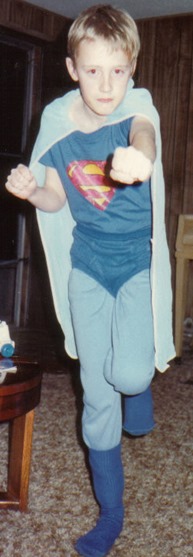
I am a huge Superman fan. My favorite movie of all time is not a Star Trek film, a Star Wars film, or even a Disney film, it’s 1978’s Superman: The Movie. When I wasn’t pretending to be Captain Kirk as a kid, I was zooming around the house in my makeshift Superman costume with John William’s soundtrack blaring in the background.

superdaveI am totally serious about that

I love Superman. And even though I went through a very brief teenage phase where I thought Spider-Man was cooler because he was angsty and Todd McFarlane drew him, the Death of Superman arc in the early 90s pulled me right back into Superman fandom.

These days I’m not a regular reader of the comics, but my favorite stories include most of Grant Morrison’s work (especially All Star Superman) and Mark Waid’s Kingdom Come and Birthright. You could say I prefer the more classic Superman that has fun, science fiction-y adventures and a strict moral code.

And I liked Man Of Steel.

You’re probably wondering if you read that wrong. How could a guy who loves the colorful, funny, lighthearted 1978 film also like the desaturated, grimmer, more somber 2013 edition? How could a guy who loves the version of Superman whose greatest power is his instinctive knowledge of right and wrong and who’s sworn never to use his power to take a life enjoy a film where the Last Son of Krypton snaps a guy’s neck?

Well, let me go ahead and talk about the Zod Neck Snap since it is the most controversial element of the film. I’m a big believer in the Superman Doesn’t Kill rule. If Superman breaking Zod’s neck was presented as one of those moments where the audience is supposed to cheer, if Superman looked at the camera and tossed off a snarky one-liner after he did it, then I would be very angry indeed, and this post would be all about what idiots the filmmakers are. But that’s not what happened, is it?

The point of the scene was to force Superman into an impossible choice: kill Zod, an act he feels is morally repellent and wrong, or allow Zod kill the family he’s threatening with his heat vision, and possibly thousands, millions or even billions more. (And no, the family couldn’t run away. That’s what I though at first, too, but their path was blocked by rubble) He didn’t have time to think about it or to formulate some kind of alternative. The options were: 1. Kill Zod, or 2. Allow Zod to kill a lot more people. Instead of our hero getting to choose between a right and a wrong, he’s forced into a situation where he has to choose between a wrong and a wrong. That’s good drama right there.  And yet, many critics argue that the writers should have sucked the drama out of the scene by giving Superman some kind of technobabble alternative. To those people, I have three words: Star Trek: Voyager.

Remember Voyager? That horrible, late-90s, “lite” version of Star Trek that is pretty much universally reviled, even among Star Trek fans? A big reason why it’s so hated is that it set up a situation where the characters would allegedly be forced to make hard choices: stuck on a small spaceship seventy years from home with limited supplies, limited fuel, no allies, and the crew divided into opposing Starfleet and Maquis factions-and then completely failed to follow through with any of it. Is that what you wanted to have the writers of this film do? And rest assured, if the writers had given Superman the last-second technobabble alternative the critics seem to want, then people would have just criticized that decision instead and accused the writers of taking the cheap and easy way out.

What it comes down to, I think, is that a lot of people (some of whom work for high-traffic sites like io9) decided to dislike Man of Steel before anything at all was known about it. And because, like any film, it has a few plot holes and imperfections, as well as some genuinely controversial story points, these things are being used as “evidence” of how bad it is by people who already decided to hate it ahead of time.

The fact is that Superman’s killing of Zod was not glorified. It was not presented as a happy, triumphant moment. It was an agonizing decision that obviously cost Superman dearly. The people who are saying things like “Man of Steel gives us a Superman who won’t hesitate to kill when he thinks it’s necessary” either haven’t seen the movie or are deliberately misinterpreting it to bolster the decision they made to dislike it in advance.

However, all of that being said there is one criticism I have of the scene, and it’s that little kids were subjected to it. The showing I went to had lots of parents with their kids, many of them 10 or under, and it’s a shame they had to see that. If for no other reason than that, I really wish the filmmakers had found another way out. Even though it would have robbed the film of some drama, even if it would have given Superman an “easy out” and allowed him to sidestep having to make a tough dramatic choice, I think that might have been preferable to subjecting kids to a scene where a man’s neck gets broken.

Moving on, although my opinions of the film differ greatly from the conventional Internet opinion of it, there’s one other criticism of the movie that I do agree with: the huge amount of destruction and the ignoring of the huge amount of civilian casualties that must have occurred. However, the problem as I see it is not that Superman fails to show concern for civilians caught in the crossfire of his superhero fight, it’s that the movie kind of forgets that these civilians even exist. Aside from a few shots of people running away from the destruction, civilians are only present when the film needs them to create peril or drama, like when Perry and Steve are trying to rescue Jenny, or when Superman is forced to kill Zod to save the family he’s threatening. In the scenes where Superman and Zod are punching each other through buildings, those buildings appear to be empty. I don’t think that was a writing decision, I think the production just didn’t want to go to the trouble to animate people diving out of the way in those shots. Overall, it goes a long way toward making Metropolis feel less like a real place and more like the final level of a Superman video game.

I’ve read some very thoughtful criticism saying it would have been nice if more drama in the Zod fight could have come from Superman desperately trying to save civilians and fight Zod at the same time, and I totally agree with it. I really believe that Warner Bros. was stung by the complaints that Superman Returns didn’t have any fighting in it and made this film a Superhero Punching Fest to compensate.

I also believe lazy writing is responsible for how life in Metropolis seems to have gone back to normal when Clark Kent comes to work at the Daily Planet, even though it seems that only few weeks or maybe months have passed. After 9/11, a sort of pall hung over New York for weeks, if not months. The disaster in Metropolis was a lot bigger; how can life have gone back to normal there when there’s a 10-mile-wide crater in the middle if the city? Obviously, having spent over two hours telling this origin story, the movie wants to wrap everything up in a nice pretty bow in the last five minutes. It’s a lot like the end of J.J. Abrams’ first Star Trek film, where Kirk is directly promoted from Cadet to Captain at the end of the movie just so it can end with him in command of the Enterprise, since that’s the familiar status quo. Since the people behind Man of Steel made a big deal about how realistic it was going to be, it would have been nice if that realism could have extended to how a city would realistically react to being half-leveled by superpowered aliens and their Evil Death Machine. But the way I see it, this isn’t a problem just with this film but with these kinds of “origin story” movies in general.

So, now that I’ve defended Man of Steel against some of the criticisms leveled against it we arrive back at the question I asked several paragraphs ago: how can a guy who loves the Christopher Reeve films and the more idealistic portrayals of Superman in the comics also like Man of Steel? Well, just because I love some of the more fantastical takes on Superman doesn’t mean I can’t also appreciate a more “realistic” interpretation of the character.

I like to see Superman’s powers visualized with modern special effects. I also appreciate how they’re consistently portrayed and don’t vary according to the needs of the plot. For example, in the 1978 film he can fly fast enough to reverse time, but not stop two missiles. And in Superman Returns, he flies right into Luthor’s Kryptonite island trap without using his vision powers to check the place out first and discover that it’s made of Kryptonite and maybe he shouldn’t land on it. If there’s any of that in Man of Steel I didn’t see it.

The acting in the film is top-notch. Henry Cavill is great. Amy Adams is the best Lois Lane we’ve ever had. Michael Shannon is an excellent Zod, with a more logical reason for his actions beyond the “cartoon villain” motivations Terence Stamp had to work with in the Donner films. I love the little story arc Christopher Meloni’s character has, and I thought Laurence Fishburne made a fantastic Perry White. I couldn’t believe the some of the negative reactions I saw when he was first cast in the role, all based around the fact that he’s African-American, and not white like all previous versions of the character. Who cares? You should get the best actors you can, and if an actor of Fishburne’s caliber is available you had darned well better cast him!

Most of all, I appreciated the film’s trying to realistically portray how people would react to the presence of someone like Superman. In the previous films  and TV shows, we’ve never seen that. Especially in the 1978 film, everyone seems just pleased as punch about the flying bulletproof space alien, and not the least bit freaked out. In some of the more recent comic book reboots of Superman’s origin, he’s been distrusted by the military at first, but as soon as he does a few good deeds that distrust is quickly forgotten (I’m thinking of Birthright and Geoff Johns’ Secret Origin here. The New 52 handles it a little better). Staying on the realism theme, I also appreciate how Lois Lane is in on Clark’s secret from the beginning, ensuring that we won’t be asked to believe than an award-winning investigative reporter can be fooled by a pair of glasses. Still, in the brief scene we saw with Clark in the glasses it didn’t look like he was putting forth any effort to try to act like a different person. It reminded me of Dean Cain’s Clark, and not in a good way. Hopefully the dual identity thing will get a believability injection in the sequel.

The fact that I enjoyed Man of Steel doesn’t mean I think everyone who didn’t is somehow wrong or not entitled to their opinion. There are several people whose opinions I respect (Mark Waid, for example) who didn’t like the movie and gave very thoughtful reasons why. And that’s fine. My only problem is with the common Internet tendency to try to appear smarter than everyone else by preemptively declaring that a piece of popular entertainment is not any good.

So those are my thoughts on Man of Steel. If you’ve read this far, then you probably deserve some kind of medal. Or maybe you just have too much spare time.