Showing posts with label Star Trek: The Next Generation. Show all posts

Monday, January 1, 2024

Star Trek: Picard Season Three—The TNG Finale Band-Aid

WARNING: This article contains spoilers for Star Trek: Picard Season Three, which as of this writing has been out for the better part of a year.

In the spring of 1994 Star Trek fans were treated to the wonderful TNG finale "All Good Things". It was a little technobabble-heavy, but it was still an affectionate send-off to the TV adventures of the Enterprise-D crew as they made the jump to the big screen.

And then the movies made a concerted effort to shed everything audiences liked about The Next Generation. The first movie unceremoniously disposed of the Enterprise-D, and the next one replaced it with a sharp-edged warship. First Contact also jettisoned the TV show's bright and peaceful ethos to go in a much darker, more violent direction. This seemed cool in the mid-90s, but it didn't really age well. Insurrection was the only movie that really felt like The Next Generation, but at the time it seemed like more of the Rick Berman risk-averse blandness that so infuriated us on Voyager. But the final insult, the nail in the coffin of The Next Generation era, was 2002's Star Trek Nemesis. Instead of a well-crafted farewell like The Undiscovered Country, we got a mean-spirited, cynical ripoff of The Wrath of Khan that ended on a depressing note with Data's pointless death.

It was as if the people in charge of making Star Trek: The Next Generation movies didn't really like Star Trek: The Next Generation. And that wasn't too far from the truth, because Sir Patrick Stewart had a tremendous amount of creative control on them. Sir Patrick spent most of the TV show's 7-year run complaining that his character didn't get to do enough action, and he was the driving force behind turning Movie Picard into a phaser-rifle-toting, dune-buggy-driving action hero who bore only a superficial resemblance to the character audiences enjoyed on TV.

But old-school TNG fans somehow forgot about this in 2018, when Star Trek head honcho Alex Kurtzman announced that that they were bringing back Patrick Stewart in a new streaming series called Picard. For some reason, we hoped that Sir Patrick would help to undo the damage that was caused by his own creative input on the movies. Unsurprisingly, our hopes were crushed like a Fudgesicle on a Florida interstate highway when Picard's first two seasons were (and here I am being diplomatic) a steaming pile of rhinoceros crap.  It turned out that Sir Patrick's number-one condition for reprising the role of Picard was that his character would not be sitting in the Captain's chair of a Federation starship and doing any Star Trek stuff that audiences might actually want to see. It was like if Peter Cullen would only voice Optimus Prime on the condition that the character not turn into a truck, say "Roll out", or fight any Decepticons.

But for Season Three, producer Terry Matalas was like "Hey, what if we put some Star Trek: The Next Generation in this Star Trek: The Next Generation sequel show?" and Sir Patrick amazingly went along with it. And the season was a hit. Even people who had been throwing nonstop tantrums since the Discovery premiere enjoyed it. But why? Was it because the show rejected tightly-serialized storytelling in favor of a more episodic approach, like TNG in the '90s? Actually no, it was basically one long ten-hour story. Ah, but was that story at least more straightforward, rather than the convoluted, contrivance-ridden storytelling of most other streaming shows? 

Again, no. It starts with our characters confronting a mysterious threat that turns out to be rogue Changelings who were captured during the Dominion War and subjected to cruel experiments by either Starfleet or Section 31 to turn them into the perfect spies. (Why they would agree to work for the Federation, especially after being horribly mistreated, is never explained)  But then, with only two episodes left in the season, it's revealed that the Borg Queen was behind it all as part of a plan to use Picard's heretofore-unknown son Jack to mind-control all Starfleet officers under the age of 25 so they'll destroy Earth.

So why did middle-aged Star Trek fans who have hated all the other new productions enjoy Picard's third season? I think it's because we finally got a Star Trek: The Next Generation thing that was made by people who actually like Star Trek: The Next Generation. It's the first TNG production in thirty years not made by people who were way up their own butts the whole time. Picard Season Three is basically a professionally-made fix-fic. A fix-fic is a piece of fan fiction written to "fix" a boneheaded creative decision made by clueless studio executives, producers, or actors with too much creative control who didn't like or understand the source material. And that's exactly what the season does. 

Right away it brings back Beverly Crusher and explains her absence from the show thus far. It brings Riker and Troi out of their retirement living in the woods and making pizza. It brings back Geordi and gives him a family, thus undoing the damage done to the character by the Leah Brahms episodes that made him look like a creepy incel. We get to see an older version of Worf doing cool Worf-related things, and his relationship with Raffi Musiker greatly enriches that character. We even get to see Ro Laren again, and we get some wonderful closure to her and Picard's relationship. Best of all, Data is finally rescued from years of breathtakingly stupid creative decisions and restored in a new form that's unmistakably Data, while finally giving him the humanity he'd been seeking all along. This leads to some wonderful moments between Data and Geordi, whose friendship was mostly ignored in the movies. Last of all, the season restores TNG's most horribly-treated character, the Enterprise-D. The beloved starship is finally depicted as something precious and worth preserving, rather than a boring old thing that the show can't wait to ditch in favor of something sleeker and pointier. The season ends on an "All Good Things"-inspired high note, with our beloved TNG family enjoying each other's company around the poker table.

At last, The Next Generation has gotten the well-crafted ending it deserved, and the fans are finally satisfied.

Ha ha! Obviously I'm kidding about that last bit. Fans are never satisfied. When we get something we like, we demand a never-ending stream of that exact thing to be continuously shoveled into our content-consuming orifices until the heat death of the universe. For his part, Terry Matalas whetted our appetites by using the last moments of the Picard finale to set up a potential new series called Star Trek: Legacy with Captain Seven of Nine, First Officer Raffi, and Starfleet Nepo Baby Jack Crusher-Picard on the Enterprise-G. I'm going into Bold Prediction Mode here to say it'll never happen.

As I write this in January 2024, the Internet Streaming Revolution is in a similar place as the dot-com boom in the late-90s. Back then, the Internet was this exciting new thing and there were tons of new Internet-related companies with the following business model:
  1. Do something Internet related, with a website and stuff.
  2. ???
  3. Profit!
You know how that went. Streaming is the same thing. Hollywood has been trying to replace their old business models with streaming services, but no matter what they do the services can't make a profit. Even worse, when they try to attract subscribers with popular intellectual properties like Marvel or Star Wars, the streaming versions of those things tend to dilute and cannibalize the formerly-profitable films. This has led to studio executives like Warner's David Zaslav frantically throwing newly-completed films and older legacy productions into the shredder in a desperate attempt to stop the bleeding. Which is kind of like demolishing the entire east side of your house so it won't be damaged by the electrical fire on the west side. Eventually studio mergers are going to leave us with two or three streaming services that offer no TV shows or movies.

All this is to say that we'll be lucky to get any new Star Trek beyond the stuff that's in active production as I write this. And if the rumored Paramount-WB merger happens, there's no guarantee that even those things will see the light of day; David Zaslav might burn them down for the insurance money. 

So buy physical-media versions of all the stuff you love. And don't hold your breath for Star Trek: Legacy.
Saturday, May 7, 2022

The Star Trek: Picard Dumpster Flambé

You may recall that I was a wee bit critical of Star Trek: Picard's first season on account of how the story didn't make any sense. Of course I wasn't angry at the show. It didn't hurt my feelings. I was just disappointed that I wasn't able to enjoy something I thought I was going to like.

Now, I'm going to talk a lot about story and character and all that stuff, but I should point out that I am a fairly nerdy Star Trek fan. I have all the tech manuals and I've read each of them cover to cover many times. I actually understand what all the technobabble means. I regularly pause episodes to scrutinize the LCARS panels. And I shared the disappointment of people who acted like Season One's main failing was that big fleet of identical, hastily-rendered Starfleet vessels in the finale. But ultimately those things are just minor details. Complaining about them would be like complaining that the flames shooting out of the Hindenburg were the wrong color.

But I'm not comparing Star Trek: Picard to the Hindenburg. The Hindenburg actually flew for a while before it burst into flames.

So, what's Season Two of Star Trek: Picard about? Isn't THAT the million-dollar question? Stories told in fairly compact chunks, like two-hour movies or one-hour episodes of older TV programs like Star Trek: The Next Generation (to pick a totally random example), always tell you what they're about pretty early in the story. But for some reason, people who write for this show think it's a really great idea to tease the actual point of the story for as long as possible. I'm not saying that nothing happens in Season Two, far from it. All kinds of things happen. So many things! But we don't understand the point of it all until the season is 90 percent over.

And what's the point?

Well, it's all about how Picard has never been able to settle down and commit to a woman because of a deep, dark childhood trauma. Now, you might think that being assimilated by the Borg or tortured by the Cardassians or getting his brain zapped by an alien probe that made him live an entire lifetime in 45 minutes would've messed him up way more than anything that could've happened to him growing up on a vineyard in France about two hundred years after war, poverty, and disease were eliminated on Earth. But that's because you watched Star Trek: The Next Generation, and whoever decided on this storyline obviously did not.

No, Picard's big trauma, which is endlessly teased and hinted at but not fully explained until episode 9 of a 10-episode season, is that his mom was mentally ill but refused all treatment, and one day after a particularly bad episode, his dad locked in her in her room until he could get her some help. But she pleaded with Jean-Luc to let her out, and since he was too young to understand what was going on he used a skeleton key to unlock her door, and she went to the atrium and hung herself.

But an unfocused time-travel caper to the year 2024 makes it all better, and before returning to the 25th century Picard deliberately leaves the skeleton key where his little-kid self will find it in the future so his mom can get out of her room and commit suicide. Unburdened of his trauma, he goes home to make out with his new girlfriend in the very room where his mommy killed herself! I mean, do I even HAVE to talk about how grotesquely sociopathic and horrible this is? 

I would truly love to find out exactly how this turd sandwich was made. We'll probably never get the whole story, but to me it has all the symptoms of an ego trip vanity project like the movies of Neil Breen (which he writes, directs, and stars in). If you sit through a Neil Breen film (or even a humorous Internet review of one) two things are clear:
  1. Mr. Breen sincerely believes that he makes movies to communicate the Big Important Ideas in his brain.
  2. None of his ideas are all that big or important, and he is not very good at using the medium of film to communicate them.
For example, in his movie Fateful Findings, Neil Breen's character gets hit by a car and gains incredible computer hacking powers, which he uses to make the shocking discovery that politicians take money in exchange for political favors, and big bank executives manipulate the financial system to make themselves very rich! Neil exposes their wrongdoing to the world, which somehow leads to a press conference scene where all the politicians and corporate executives take turns stepping up to the lectern, confessing to their crimes, and immediately committing suicide while Neil Breen stands off to the side and smiles like an idiot. Obviously Breen was trying to say something meaningful about societal injustice, but managed to do it a clunky, ham-handed manner that made him look like an awkward sociopath.

In the same way, this season of Picard was trying to say something meaningful about how grief and trauma can keep us rooted to a point in our past. But in the process they had Captain Picard deliberately enable the suicide of his mentally ill mother, and this was framed as a good thing! It's no less ghoulish than Neil Breen standing there with his creepy, vacant smile while a procession of people step up to a press conference and shoot themselves!

If anyone is to blame for all this I have a hunch it's Sir Patrick Stewart. Sir Patrick is a great actor. He's better at acting that I will ever be at anything. His success has earned him a hefty amount of clout, which translates into creative control over the projects he chooses to do. But here's the thing: he's only good at acting

All the other stuff that goes into a writing and producing a TV show call for several different skill sets. And just because someone is good at one or two of those things doesn't mean they're good at all of them. Patrick Stewart had little or no control over his character on Star Trek: The Next Generation, and it was a huge hit. But as soon as they started making movies, he got creative control, and his notes on the scripts almost always made things worse. Brent Spiner once joked that the main difference between the TV show and the movies was that fewer people saw the movies.

I'm willing to bet that even fewer people are watching Star Trek: Picard.

Tuesday, January 25, 2022

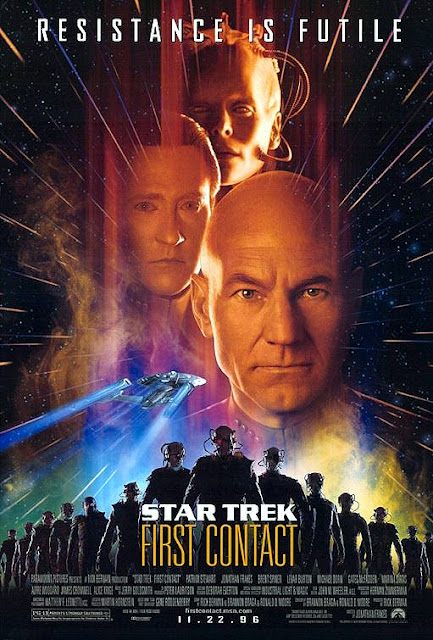
The First Contact Retrospective

Sometimes I wonder how the people who are always complaining that Discovery isn't "real" Star Trek would react to a big-screen reboot of The Next Generation that reimagined that era's starship Enterprise as a warship captained by a grim, revenge-obsessed Captain Picard. What if it was more darkly violent than any previous Trek film, and relegated the optimistic Roddenberrian message to a paper-thin B-plot? If that ever happened, I'll bet the online Star Trek Fundamentalists would throw a massive Internet tantrum that would make the furor over The Last Jedi look like a polite disagreement.

Oh wait, that happened in 1996 and they loved it:

The 1990s were a weird time. We had a movie where the Teenage Mutant Ninja Turtles danced with Vanilla Ice. Pauly Shore had a career. And amazingly, against all reason, we had a dark and gritty Star Trek: The Next Generation reboot that the very same fans who now rail against modern Trek for being too dark and violent absolutely loved. How did this happen?

It's worth remembering that the original show was made during the Vietnam War by World War II and Korean War veterans, in a world that lived under the constant threat of Mutually Assured Destruction. The idea that conflicts should be solved with words instead of weapons was a somewhat-radical notion that greatly appealed to the show's young audience, most of whom were personally affected by Vietnam in one way or another.

But by the time Star Trek celebrated its 25th anniversary in 1996, all that stuff was in the past. The second generation of fans grew up during a time when the Cold War was receding, the US military draft had been discontinued, and the western world was at relative peace. The cartoons that entertained us as young kids were the Transformers, GI Joe, He-Man, and even R-rated characters like Rambo and Robocop that had been repackaged for children. All of them were about factions of good guys and bad guys attacking each other with lethal force. (Although nobody ever died or got hurt unless it was time to refresh the tie-in toy line.) Yeah, a lot of those shows had a "moral" at the end, but it kind of got lost after the previous 20 minutes of nonstop fighting.

In 1991 our generation experienced its very first war, the weeks-long Gulf War. It was fought by a small, all-volunteer force and packaged as entertainment by the 24-hour TV news networks. (CNN even gave it a logo and theme music.) Not much of the coverage bothered to delve into the inherent complexities of a conflict in the Middle East. They framed it as a battle of Good vs. Evil; a live-action version of the GI Joe cartoons we consumed in in the '80s. There were serious consequences and real human costs, of course, but the American media didn't really stick around much to cover those.

During the 1990s our generation grew from rambunctious kids to rebellious teenagers. Teenagers of our parents' generation had rebelled by becoming anti-war, flower-power hippies; we rebelled by doing the opposite of that. Our favorite video game was Mortal Kombat, a fighting game where the victorious player could gruesomely murder their opponent by entering a character-specific combo. Our favorite superhero comics were "extreme" Image titles like this:


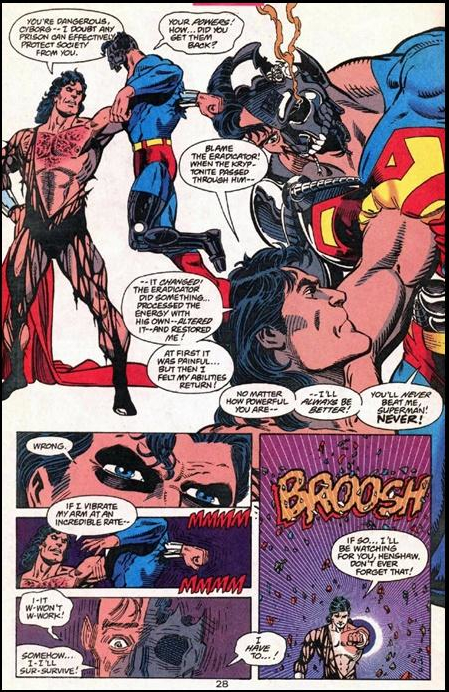
We liked "heroes" with names like BloodGun and MurderBlade and Slaughter Ninja who did stuff the Super Friends would never dream of, like smoke, drink, curse, and above all else kill their enemies. In these kinds of stories, peace was the coward's way out. "Real" heroes showed their bravery by doing what "needed" to be done i.e. kill the bad guy. Even Superman wasn't totally immune to the trend:


Granted, he went back to his old self two pages later, but for the majority of that issue he was wearing black and toting a ridiculous amount of guns

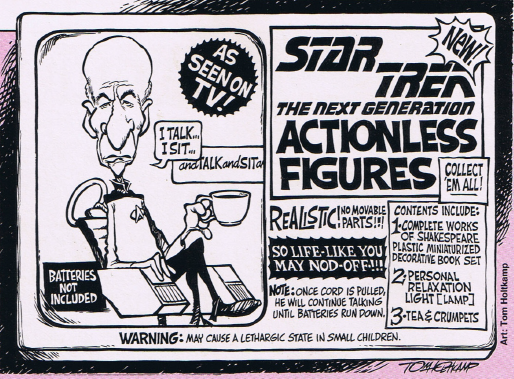
What I'm trying to say was that the young Star Trek audience in 1996 wasn't a bunch of socially-conscious peaceniks. We were stupid adolescents who saw violence as empowering and fun, but we had zero understanding of its real-world consequences. As much as we enjoyed Star Trek: The Next Generation, we tended to think of Captain Picard as kind of a boring wimp who talked too much:


From a 1994 issue of Starlog

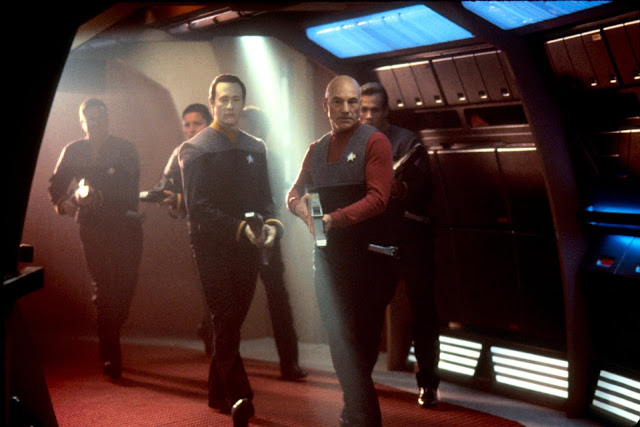
So when the first stills from the movie showed up in Star Trek Communicator magazine, featuring scenes like this one with an action-oriented Picard leading a security team with beefy phaser rifles down a darkened corridor, we were stoked:


And when we saw a sweaty, rage-filled Captain snarl that "the line must be drawn here!" in every trailer and TV spot (along with shots of the biggest space battle in Star Trek history up to that point) we totally lost our minds. 


First Contact was shaping up to be the most action-packed, testosterone-filled Star Trek in history. But it was also the first one to be rated PG-13. People forget what a big deal this was; it gave Star Trek the same cachet as other sci-fi action blockbusters like Independence Day or Jurassic Park. For the first time in ages, Star Trek was dark and edgy and dangerous. And in 1996, we loved it.

Today, First Contact is older than the entire Star Trek franchise was in 1996. And it doesn't hold up particularly well. Yes, it's the best of the TNG films. But here's the thing: none of the TNG films are good. My apologies if you enjoy them. By all means, go right ahead. But in my opinion, they're all bad. They all suffer from tiny budgets and the hand of a TV producer who didn't really like or understand Star Trek. First Contact feels the most "liberated" because it's the only one that wasn't made with some kind of creative mandate imposed by meddling executives.

And even though Picard works through his feelings of rage at the end (by killing his enemy, it should be noted), the movie commits the unforgivable sin of turning the Starship Enterprise into a warship. I'm all for Star Trek stretching its formula in new and different ways, but an inviolable part of its DNA is that the Enterprise is a ship of peace. The bad guys travel around in warships and battlecruisers, not our heroes.

After twenty-plus years of wars, mass shootings, and terrorist attacks we've come back around to the ideal of TV Picard who used reason and diplomacy to solve problems. The angry, gun-toting action hero on a revenge quest, who we thought was so cool when we were stupid teenagers, turns out not to be what we needed after all.

Monday, September 28, 2020

Encounter at Farpoint

“Encounter at Farpoint” is the Phantom Menace of televised Star Trek. 

You see, when Star Trek: The Next Generation premiered with “Encounter at Farpoint” in September 1987, it was the first new live-action Star Trek TV episode in almost 20 years. Sure, we'd been getting a new movie every couple of years since 1979, but the fans were desperate for more. The idea of a new weekly show helmed by The Great Bird of the Galaxy Gene Roddenberry himself, remaking Star Trek as only he knew how, sounded great. It was a lot like the excitement Star Wars fans would feel in the 1990s when they learned that George Lucas would be returning to the franchise to make more movies.

And although Star Trek: The Next Generation would end up being a much bigger creative success than the Star Wars prequels, the opening stanza of each is similar in the sense that it’s frequently boring, dysfunctional, and ultimately unsatisfying.

Also, two of their main characters have a very similar fashion sense:

farpoint_hd_760 amidala

So, let’s take a look at Star Trek: The Next Generation’s maiden outing, and all the weird little problems it has.

Number 1: The Q Subplot

Believe it or not, the character of Q was actually a late addition to the story. Originally, TNG’s premiere was to have been a regular one-hour episode. Veteran Star Trek writer DC Fontana developed a story where the Enterprise comes to the rescue of a peaceful spaceborne lifeform that’s being held captive by an aggressive alien species.

But then someone on the upper end of the food chain decided that Star Trek’s return to television should be a two-hour TV movie “event”. Suddenly, the story had a whole second hour to fill. How would they do it? With one of Gene Roddenberry’s favorite Star Trek tropes: humans proving their moral worth to a skeptical godlike being.

As I’ve written in the past, by the mid-80s Gene Roddenberry was the lone resident of an alternate universe where the sole reason for Star Trek’s success was his high-minded “vision” of the future. He seriously believed that audiences would rather watch characters stand around and debate 24th century philosophy than engage in a fun action-adventure story. And that’s basically the reason for Q’s existence: he’s a foil for Captain Picard to speechify at.

Now don’t get me wrong; John de Lancie did an amazing job bringing life to the character. But if you just read the script, Q comes across as a rather one-dimensional and cartoony villain. Only de Lancie’s performance brings a sense of depth and menace to the character.

Nevertheless, the addition of the Q subplot highlights another huge problem with “Farpoint”:

Number 2: The Actions of the Story’s Major Players Make No Sense

Let’s start with Q. The way he goes about things in this story is pretty nonsensical for a super-intelligent omnipotent being.

First, his major issue is that humans are a “dangerous, savage child race” that has no business being out in space. So when does he choose to appear on the bridge of a human-crewed ship to insist that they return to their own solar system? In the 24th century, after they’ve already been out in interstellar space for a few hundred years. That’s like waiting until the 19th century to demand that Europeans stay on their side of the Atlantic.

And since his problem is that humans have gone too far out into space, then you think he’d direct his complaints to the humans who are farthest away from Earth. And at the top of the show, Picard voiceovers that the Enterprise is en route to Deneb IV, “beyond which lies the unexplored mass of the galaxy”. But when they get to Deneb IV, the USS Hood that dropped off Riker, Geordi, and the rest of the crew is there in orbit. So shouldn’t Q have appeared on the Hood’s bridge and done his whole “humans are a savage race” schtick with their Captain? It’s almost like Q was aware that the Enterprise was the ship with its own TV show, and he wanted to play to the cameras.

Next we have the Bandi, Deneb IV’s cheerful inhabitants:

farpoint_hd_350

At some point they managed to capture an giant spaceborne sentient jellyfish with shape-shifting powers and force it to transform into a sleekified version of Walt Disney’s Progress City.

farpoint_hd_698Nice, but where are the monorails?

Presumably because their planet is the Star Trek equivalent of a third world country, the Bandi christened their new “city” Farpoint Station and used it to attract outside investment from more affluent species. So far, so good. But who’s the first “investor” they try to attract? The Federation, the one group that would have a problem with them exploiting a poor defenseless creature for selfish gain. Why not try the Klingons or the Ferengi?

And then, when Federation representatives like Picard or Riker meet with the Bandi leader, Groppler Zorn, he arouses their suspicion by acting as shifty and defensive as he possibly can. How did this guy manage to become leader of an entire planet? He couldn’t even manage a Burger King! And speaking of people who aren’t qualified for their jobs:

Number Three: A Lot of the Starfleet Officers Are Idiots

Part of Gene’s grand vision of the future was that humanity would “mature” into a peaceful and wise people. One of the ways that TNG’s characters were supposed to differentiate themselves from backwards 20th century humans (besides their preference for spandex pajamas) was their reaction to things that were different and alien.

Since the Enterprise’s mission was to seek contact with strange new worlds, life forms, and civilizations, it would make sense that it be crewed by people who wouldn’t immediately become fearful or violent when they encountered something alien. And if they found themselves in a tight situation, they’d remain cool, calm, and collected like modern-day astronauts or fighter pilots.

With that in mind, let’s examine how these “evolved” 24th Century Roddenberrians react when, in the episode’s opening minutes, they encounter a new kind of alien:

Q announces his presence by throwing up a giant CGI chain-link fence that impedes the Enterprise’s forward progress:

farpoint_hd_089

Then, he appears on the bridge dressed as an Elizabethan explorer and talks some trash to Picard using more thees and thous than a performer at a Renaissance Fair.

farpoint_hd_113

When some security guards burst onto the bridge with phasers drawn, Q traps them in the turbolift:

farpoint_hd_098

So far-and I can’t stress this point enough-Q has done nothing violent. He’s just stopped the ship from moving and been a jerk to everyone. For his part, Captain Picard certainly doesn’t overreact to the situation. He calmly asks Q what he wants and engages him in debate to learn more about this strange new life form. But the people under his command don’t follow his lead.

First, Lieutentant Redshirt McDeadmeat decides that the best way to react to this trash-talking alien with godlike powers is to try to shoot him. Q responds by going all Mr. Freeze on him:

farpoint_hd_105

Picard is furious, but not at his idiot crewman who tried shoot an alien who hadn’t done anything overtly threatening yet. He’s mad at Q for not letting himself get shot!

So anyway, Q changes costumes a few more times (seriously, he changes clothes more than Queen Amidala. Does he want to put humanity on trial or have a fashion show?) and then disappears, promising to return. Captain Picard decides that since they can’t go forward, they’ll turn the ship around and run away as fast as they can. Unfortunately, Q’s CGI chain-link fence turns into a giant flying Fireball of Doom that pursues them at warp speed.

After Picard decides to separate the saucer to get the children and families out of harm’s way, the command crew transfers to the Battle Bridge. And it is here that we start to wonder how elite this Enterprise crew really is. Because Lieutenant Tasha Yar, Chief of Security, the person responsible for the safety of the Enterprise’s 1000 crewmembers and the officer the Captain relies upon for sound tactical strategy mounts an impassioned plea to get Picard to let her shoot phasers at the Giant Warp Speed Fireball of Doom. As if that would do anything. And a few minutes later during the Q’s courtroom scene she almost gets herself killed when she has a truly hilarious overblown dramatic freakout.

It really makes you wonder what’s going on at Starfleet Headquarters. One imagines that the job of Security Chief on the new Enterprise would be a highly sought-after position. There was probably a big pool of qualified applicants to choose from. So why did Starfleet go with the gun-happy drama queen whose response to anything unexpected is to freak out and try to shoot it? 

And then we come to Worf. He doesn’t have much to do in the episode other than be the Token Klingon, an example of Star Trek’s new 24th Century status quo. But there’s this scene two-thirds of the way in where Q appears on the viewscreen to taunt Picard a little bit, and Worf does this:

farpoint_hd_497

Yes, he tries to shoot the viewscreen because it’s showing a picture of the bad guy. At this point, Picard should just revoke Worf’s phaser privileges. Heck, he shouldn’t even be allowed to eat with a fork! He’s clearly a danger to himself and others. Still, the Big Dumb Stupid Worf moment does give us something to chuckle at, which is nice because it distracts us from:

Number 4: The Ridiculous Amount of Padding

As I mentioned earlier, the TNG pilot was extended from a one-hour to a two-hour show fairly late in the game. D.C. Fontana was definitely a good-enough writer to come up with an additional hour of material, but Gene Roddenberry was keen that he receive a writing credit on the new show's inaugural episode, so he pulled rank and bolted the Q subplot onto the existing story. Only Roddenberry's skills had deteriorated by 1987 and he wasn't capable of coming up with enough interesting things to fill the additional time.

So what we got was padding. Lots of it.

The padding starts with the initial Q encounter. All that really happens is that Q shows off his costume-changing powers while he and Picard argue about whether humanity is a dangerous savage child race or not.

Then the Enterprise runs away and Q chases them, so they separate the saucer and then Q spirits Picard and company away to his post-apocalyptic courtroom so he and Picard can have basically the same argument they had at the beginning of the show. This renders everything that happened from Q’s first appearance to the start of the courtroom scene ENTIRELY POINTLESS. It would have been much better from a story perspective to have Q bring Picard and his officers into the courtroom for their first encounter.

An even more egregious example of padding happens after Commander Riker comes aboard. Before Picard will talk to him, he makes Riker sit at the back of the bridge and watch what’s essentially a clip reel of the episode up to this point.

farpoint_hd_400At least Picard could have let him get some popcorn

Usually your cheesy 80s shows waited until later in the season to have a clip show, when money was tight and the writing staff was out of ideas. Working a clip reel into your pilot episode may be a television first.

Hey, remember that whole “mystery of Farpoint Station” you were supposed to be solving? When are you going to get around to that?

I understand that one of the functions of a pilot episode is to introduce the characters and their world. But a well-written pilot would do that while moving the plot forward. In “Encounter At Farpoint”, however, the plot keeps getting put on hold so we can have these little expository scenes. Don’t get me wrong, some of them are nice. But the constant digressions away from the main story to introduce this or that character or piece of technology really end up hurting the episode because we find ourselves constantly waiting for things to get moving.

Unfortunately, that doesn’t happen until almost three-quarters of the way into the episode. And our characters solve the mystery of Farpoint Station pretty quickly. Which isn’t too surprising, after all Groppler Zorn’s not much smarter than your average Scooby-Doo villain.

farpoint_hd_869“And I would have gotten away with it too, if it hadn’t been for those nosy kids in their spandex pajamas!”

It’s certainly better than doing the thing where the solution to the puzzle is blindingly obvious but you need to pad out the episode so you make your characters too stupid to figure it out until there’s only five minutes left. However, it has the unintended side effect of making Q’s promise that the Farpoint mission would be a test of the worthiness of the human race ring a bit hollow.

But wait! Haven’t I forgotten something? Don’t I want to make fun of Wesley Crusher? No. No, I don’t. While some of the scenes with him are part of the unnecessary padding I talked about earlier, I actually like Wesley. I’ll talk more about that in a future post.

But for now, I’ve said my piece about “Encounter at Farpoint”. It’s a weird, dysfunctional couple hours of television. And yet, TNG would get worse before it got better.

If you made it this far, thanks for reading! And if you didn’t make it this far, then I guess it doesn’t matter that this post doesn’t have a clever ending.

Tuesday, August 18, 2020

The Picard Plotting Problem

Way back in the prehistoric mists of 1999, the creative team behind Deep Space Nine closed out the show's seven-year run with a ten-episode finale arc. It was a ridiculous challenge, especially with the hectic pace of 1990s TV production. The writers had never done a ten-episode arc before, and this one had to not only be internally coherent but also wrap up all the threads from the previous seven years of storytelling. And while DS9's finale arc isn't 100% perfect, it's very well-executed. The story hangs together pretty well, and all of the character's actions flow naturally from their pre-existing motivations and personalities.

The writers of Star Trek: Picard were in a much better position. Their ten-episode arc was a standalone story, not the back half of a 26-episode season, and they had much more time to develop it. The majority of the series regulars were original characters, and the few regulars that came from previous Star Treks (i.e. Picard and Seven of Nine) hadn't been seen for years, which gave the writers some creative "wiggle room" in how they'd be portrayed.

So how would this new creative team tell the story of Jean-Luc Picard's twilight years? By giving us a very convoluted, mystery-box story full of flashbacks. Is it good? To help us answer that question, I created this list of all the show's major events in chronological order.

  1. The planet Romulus is threatened by a supernova, so the Romulans ask the Federation for help to evacuate their solar system. The Federation agrees, somewhat unwillingly, and Admiral Picard oversees the construction of a fleet of transport ships at the Utopia Planitia shipyards on Mars.
  2. The Utopia Planitia shipyards are using "synths" (i.e.mass-produced not-quite-sentient androids) as unpaid labor. Picard is 100% okay with this, even though he strenuously argued against using androids as slave labor in one of TNG's most pivotal episodes, "The Measure of a Man".
  3. The head of Starfleet Security, Commodore Oh, is a secret Romulan spy and the leader of an ancient and very secret Tal'Shiar splinter group called the "Zhat Vash" whose sole purpose is to eliminate artificial lifeforms. Her assistant, Lt. Rizzo, is also a disguised Zhat Vash agent named Narissa.
  4. Why do the Zhat Vash hate androids? It turns out there's a planet in an 8-star solar system that has this laser table thing left behind by a long-dead civilization, and when you touch it it puts images in your brain of an AI-induced holocaust very similar to the one they were trying to prevent in season 2 of Discovery. Anyway, going to the planet and receiving the laser table vision (which they call the Admonition) is part of the Zhat Vash initiation ceremony; those who aren't driven insane by it are left with a fanatical desire to wipe out all artificial life forms to keep them from destroying all the organic life in the universe.
  5. At this moment of maximum peril for the Romulan people, Commodore Oh and the Zhat Vash decide it's time to scare the Federation into banning all synths. They do this by hacking the synth laborers on Mars to make them attack and destroy the Utopia Planitia shipyards, the very place where the fleet of ships to rescue their people are being built.
  6. It's safe to say that the synths weren't manufactured overnight. There was probably a long R&D process, too. If the Zhat Vash really believe that the presence of any artificial life will inevitably lead to a universe-spanning Skynet, wouldn't they have sabotaged the project to keep the synths from being created in the first place? Why do they wait until a whole bunch of synths are already built, then hatch a plan that mainly just gets a bunch of Romulans killed? These are excellent questions that nobody (least of all the writers) seem to have considered.
  7. As a result of the Mars attack the Federation Council immediately bans synths and never conducts an investigation into what caused them to go haywire in the first place. Even though the attack killed millions of people and led to the near-death of an entire race, no one but Picard's former attache Raffi is interested in figuring out why it happened, and everyone treats her like she's crazy. She even loses her Starfleet career. 
  8. The Federation was never that crazy about helping the Romulans anyway, and now that the rescue fleet they were building is gone, they cancel the Romulan relief effort. Picard resigns from Starfleet in protest.
  9. Since his life's work is now banned, Dr. Bruce Maddox leaves the Daystrom Institute on Earth and sets up shop on the remote world of Coppelius, where he starts building androids based on Data. At some point, Noonien Soong's hitherto-unknown twin son Altan joins him. The Soongs obviously have the same weird genetic condition as the McFly family that causes all male descendants to look exactly alike. 
  10. Five years later the USS ibn Majid encounters two representatives from a unknown race of androids. When the Captain reports to Starfleet, Commodore Oh orders him to kill the androids immediately without trying to learn anything about their origins, threatening to destroy the ibn Majid unless he obeys. She then immediately classifies the incident. I guess the head of Starfleet Security has broad dictator-like powers that are never subject to review by any other Starfleet or civilian authorities. The location of the android's home planet remains a mystery.
  11. Fifteen years after the attack on Mars, Bruce Maddox sends twin android sisters Dahj and Soji to discover the truth behind the attack and resulting synth ban. However, he erases their memories and implants false ones to make them believe they're human. Supposedly this is to protect them from whatever shadowy anti-synth forces orchestrated the ban, but because they closely resemble one of the androids encountered by the ibn Majid ten years earlier the Zhat Vash instantly recognize them. 
  12. Commodore Oh and the Zhat Vash are suddenly very interested in finding Dahj and Soji's home planet, even though they've known about its existence for the last ten years and haven't bothered trying to find it before now.
  13. After sending Dahj and Soji on their mission, Maddox leaves the safety of Coppelius and borrows a bunch of money from an underworld figure named Bijayzl (whose main business is chopping up ex-Borg and selling their implants) to set up a new lab on a different, easier-to-find planet.
  14. The Zhat Vash agents on Earth attack Dahj and try to extract the location of the android homeworld from her brain, but this only serves to "activate" her and she kills them all thanks to her automatic defensive programming. However, this does not restore her memories of who she is, where she came from, and why she was sent to Earth. Instead it triggers kind of a post-hypnotic suggestion to seek refuge with Jean-Luc Picard, a 93-year-old retiree with no idea of what's going on.
  15. Dahj shows up on Picard's doorstep. He quickly deduces that she's an android "relative" of Data, but because he's just an elderly retired civilian he's unable to stop the Zhat Vash from assassinating her.  
  16. Meanwhile, Soji has been given a job as a guest researcher on a deactivated Borg cube in Romulan space. Maddox placed her here so she could hack into Romulan databases for clues about the truth behind the synth ban. Since a direct, brutal approach failed to get any information from Dahj, Zhat Vash agent Narek (Narissa's loser brother) decides to try a different approach with Soji: he'll use his penis.
  17. A note about the Borg cube. Narissa and her aunt both underwent the Admonition, but it drove the aunt insane. She was on her way home to Romulus when a Borg cube assimilated her ship, but the effects of the Admonition caused the Borg cube to "break" and it was severed from the Collective. Now it's a dead artifact, and the impoverished remnant of the Romulan Empire makes money by harvesting and selling its tech. They also host research teams from other planets, and even administer a reclamation project where the drones are de-Borged, brought out of suspended animation, and helped to live normal-ish lives.
  18. Picard learns that Dahj had a twin and resolves to save her from suffering the same fate as her sister. But there's just one problem: he doesn't know where she is. Somehow he figures out that Bruce Maddox may know, if only he can be found. He hires a civilian ship, the La Sirena, recruits his old attache Raffi, and is joined by former Maddox colleague Agnes Jurati.
  19. The Zhat Vash destroy Bruce Maddox's new lab. He escapes and runs to the shady Borg-butchering criminal he owes money to. It doesn't go well for him.
  20. Raffi discovers that Maddox is on the planet Freecloud.
  21. Instead of going directly to Freecloud, Picard orders the La Sirena's Captain Rios to set course for the planet Vashti where a bunch of Romulan refugees live. You see, his motley crew has a traumatized ex-Starfleet pilot, a computer hacker, and a scientist lady, but since they're likely to encounter fanatical Zhat Vash agents who want to kill them with phasers, Picard decides they need a guy who's good with a sword.
  22. On Vashti, Picard finds his sword guy: a Romulan named Elnor that he abandoned as a child. They also pick up Seven of Nine during a battle with a Romulan pirate ship.
  23. Picard and friends rescue Maddox from Bijayzl, and Seven kills her in retribution for butchering Icheb years earlier in a horrible, torture-porny scene that has no place in Star Trek.
  24. Maddox tells Picard where Soji is. When they're alone, Agnes kills Maddox. But she only did it because of a compulsion put into her head by Commodore Oh via mind meld, so she doesn't get in trouble. Apparently "Your Honor, my client only killed that guy because a Romulan mind-meld made her do it" is a valid murder defense in the 24th century.
  25. Meanwhile, Soji is freaking out as she realizes she's not human. You think this would be a good time for her memories to come back, since full awareness of who she is and why she's on the Borg cube could help her protect herself and maybe even accomplish her mission. But that does not happen. Instead, the gaps in her memories and need for answers allow Narek to get the location of Coppelius from her before abandoning her in a death trap.
  26. Fortunately, Soji's android abilities kick in and she escapes from the death trap, runs into Picard, and through an extremely fortunate series of events is able to escape with him to the Planet of Rikers.
  27. After a warm and fuzzy TNG reunion, Picard and Soji rejoin the La Sirena for the trip to Coppelius.
  28. Also en route to Coppelius: a 200-ship Romulan armada led by Commodore Oh. Up until this moment the post-supernova Romulan Empire has been portrayed as a loose assemblage of third-world refugees. How they were able to build 200 advanced warships isn't explained. It's like if Somalia suddenly had a huge navy of Virginia-class nuclear submarines. Also, if the crippled remains of the post-supernova Romulan Empire are able to build and crew a fleet of 200 giant warships, the full-strength pre-supernova Empire should have been able to build their own evacuation fleet. Why did they need the Federation's help at all? This excellent question is (surprise!) never addressed.
  29. And now I need to back up a little, because while Picard and Soji were kicking it on the Planet of Rikers, Elnor and Hugh (formerly of Borg) were fighting Romulans on the Cube. Narissa kills Hugh, and then Seven of Nine shows up and leads Elnor to the Queen's chamber. Her plan? To plug herself into the cube and reactivate the dormant Borg drones. Finally, the thing that they've been teasing since the second episode! But it's a huge step. Will Seven be able to retain her humanity? Or will she again be consumed by the Borg? She makes her choice. She plugs in. And then Narissa opens a giant door and all the Borg are blown into space, so Seven just unplugs herself and there are no ill effects.
  30. Meanwhile, the La Sirena arrives at Coppelius ahead of the Romulan armada, but they've been followed by Narek in a one-man fighter. They fight, and Narek has the upper hand until the Borg cube under Seven's control comes barreling out of a transwarp conduit. Suddenly all the ships are enveloped by giant space flowers and they crash on the planet.
  31. Picard and friends walk to the android settlement (with a brief detour to the crashed Borg cube to say hi to Elnor and Seven) and meet Dr. Altan Soong and the android Sutra, who looks like a gold-skinned version of Soji and Dahj. Sutra mind-melds with Agnes to see the Admonition for herself and realizes that the Romulans had misunderstood it. They believed it was left by a society that had been wiped out by androids to warn others from suffering the same fate. But was actually left by a society of androids to warn future androids of the danger posed to them by organics, and to promise that an alliance of synthetic life from some extradimensional realm stands ready to rescue them from all organic oppressors. 
  32. Picard wants to evacuate the Coppelius androids on the La Sirena, take them to the Federation, and give an impassioned Picard Speech to compel the government to protect them. Sutra wants to use the information encoded in the Admonition to build a giant antenna to send an SOS to the extradimensional AI alliance, even though there's a very real chance that the Super-AIs will exterminate all the organic lifeforms in the galaxy and maybe even the universe. Not surprisingly, the androids opt for Sutra's plan over the nonagenarian French vintner they just met five minutes ago.
  33. Also, Picard's terminal disease that we learned about at the beginning of the show is finally starting to take its toll. Dr. Soong shows off a "golem"--basically a blank unfinished android body-- and mentions that he's working on a mind-transfer process. Gee, I wonder what'll happen with that?
  34. Soji comes around to Sutra's way of thinking and helps her build the giant antenna thing. Meanwhile, Jurati helps Picard escape confinement and they hurry to the La Sirena to try to head off the approaching Romulan fleet.
  35. On the Borg cube, Narissa is still alive and well. Her and Seven fight, and Seven knocks her into a bottomless pit. 
  36. The La Sirena and the giant space flowers face off against the Romulan armada, and there's lots of flying around and phaser firing. Picard FaceTimes with Soji and gives her an inspiring Picard Speech about what it means to be human. Then a giant Starfleet armada made up of hastily-rendered low-resolution CGI ships warps in .
  37. The androids briefly activate the antenna, and it shoots an energy beam into space, creating a sky hole through which evil robotic Doc Ock tentacles begin to emerge. But then Altan Soong deactivates Sutra by pressing the Off button on what I assume is a universal remote, and Soji has a change of heart provoked by Picard's "what it means to be human" speech. She turns off the antenna, and the sky hole collapses.
  38. The Starfleet armada, led by Captain Riker, hails Commodore Oh and tells her to stand down or he'll kick her "treacherous Tal'Shiar ass". The Romulans warp away.
  39. After Riker has a brief exchange with Picard, the Federation fleet also warps away. Not even one ship hangs around in case the Romulans come back. Picard finally succumbs to his illness and dies.
  40. Everyone is super sad and depressed because Jean-Luc Picard, star of the show Star Trek: Picard, is dead. CBS has already announced that the show will have a second season, but obviously, season two of Star Trek: Picard will have no Picard in it, because Jean Luc-Picard is dead. Nah, they weren't setting up anything with that blank android body and the mind-transferring machine. We, the audience, are supposed to sit through several sad and weepy scenes with Raffi and Elnor and Seven and Rios as they give voice to the grief that we feel at the irreversible loss of this great man, and believe that his illustrious life has finally come to an end.
  41. And then Picard wakes up in his study on Earth. Data is there too! A strange, uncanny-valley-looking Data that reminds me of the "young" Jeff Bridges in Tron: Legacy. Is this the afterlife? No, Data explains that it's a "quantum simulation". Drs. Jurati and Soong scanned Picard's brain and downloaded his consciousness here just before he died. As for Data, Dr. Maddox re-created his consciousness from the memories he downloaded into his less-advanced "brother" B-4 in the worst Star Trek movie ever made and he's been "alive" ever since, hanging out inside a futuristic Mr. Coffee on a table in a lab. This raises all kinds of fascinating story possibilities. Maybe Data could download into a new body and meet his "descendants" on Coppelius. Maybe his consciousness could be "rebooted" in the process, allowing the role of Data to be recast as a younger actor. We could see Data live again in one of the more humanlike bodies that Soji and Dahj had, experiencing the human condition instead of merely observing it. But instead, we go back to that old Star Trek trope that there's nothing more human than dying, and Data wants to die. He asks Picard to turn off his simulation when he gets back. He never asks about his best friend Geordi, or any of his other friends from the Enterprise. As far as this show's writers are concerned, Jean-Luc Picard was Data's best and only friend.
  42. And then Picard wakes up again on Coppelius. Soong and Jurati modified the golem to look like him and then downloaded his consciousness into it. It's implied that Soong might have a terminal illness and had intended the golem for himself, which would mean he made quite a sacrifice for this guy he just met yesterday. But like most interesting plot threads in this show, it's not addressed at all. Now, if you or I were downloaded into an android body we'd want to be younger or better-looking. But not Picard! He still looks and feels like a 90-year-old man, and he likes it that way! No android superpowers or extended lifespan for him! Now reborn, Picard fulfills his promise to Data by turning off the Mr. Coffee that contains his consciousness. Inside the quantum simulation, we see Data grow old and die with Picard at his side.
  43. We learn that the events on Coppelius have caused the Federation Council to rescind the synth ban. One wonders how, in the space of like two days, the entire Federation learned the whole truth about the events on Coppelius and the Zhat Vash's conspiracy, then went through all the political debate and drafting and passing of legislation necessary to reverse a longstanding policy. Of course, the writers did not wonder about this. They wanted the synth ban to be gone, and so it is with a magical dialogue handwave. What are the implications of this? Does it mean a resumption of android slave labor? And what about Commodore Oh? Will she be brought to justice? Is Starfleet going to conduct some kind of investigation to find out how a Romulan agent managed to worm her way to the top of their organization and find how much damage she did? None of these questions are addressed or even mentioned.
  44. Picard and his cobbled-together crew are reunited on the La Sirena. Picard looks around appreciatively, and gives the order to "Engage!"
  45. But wait, where are they going? This isn't a Starfleet vessel on an open-ended exploratory mission, it's a cargo ship for hire. The job Picard hired Captain Rios for is done, so everybody has to go their separate ways now, right? Like, are they just going to fly around and randomly do stuff until the ship runs out of fuel because Rios isn't doing jobs any more and couldn't afford a trip to the gas station?
I can't believe that professional writers are responsible for this horrible mess of a story. So many characters do so many nonsensical out-of-character things simply to move the plot along. If the answer to the question "Why did this character take this action?" is always "So the story can happen" then your story needs more work. 

The true behind-the-scenes story of how the first season of Picard was written and filmed may never be told. Heck, some of the behind-the-scenes stories from the Original Series didn't come to light until some of the people involved had died of old age. I strongly suspect that Michael Chabon came up with the final Picard-Data scene first, and then he and the other writers worked backward to construct a plot around it. You can see the needlessly-complex mystery-box plotting that Alex Kurtzman lifted from J.J. Abrams here, and I think it's very telling that Patrick Stewart had a measure of creative control, too. Stewart had significant story input on the TNG movies, too, and in almost every single instance it made the movie worse. Kristen Beyer is the only member of the writing staff I have any faith in; she established her Trek bonafides with a successful series of Voyager novels before CBS revived Star Trek for TV. The rest of them all claim to be Star Trek fans, but that's probably just publicity. Their work is proof that they don't understand the universe they're working in.

I'm rapidly approaching my mid-40s, and I've been a Star Trek fan all my life. But this may shock you: I don't care much about Star Trek canon. What I want is to see believable and compelling characters in interesting, well-told stories that stay true to the spirit of Star Trek. All in all, I think the best piece of advice ever given to Star Trek writers appeared in Gene Roddenberry's show bible for The Original Series:

AND SO, IN EVERY SCENE OF OUR STAR TREK STORY...

... translate it into a real life situation. Or,
sometimes as useful, try it in your mind as a scene
in GUNSMOKE, NAKED CITY, or some similar show.
Would you believe the people and the scene if it
happened there?

IF YOU'RE ONE OF THOSE WHO ANSWERS: "THE CHARACTER ACTS THAT WAY BECAUSE IT'S SCIENCE FICTION", DON'T CALL US, WE'LL CALL YOU.


Sunday, August 19, 2018

In Defense of Wesley Crusher

It's the moment that gave birth to Star Trek fandom's first hate group, and it happened about halfway through The Next Generation's two-hour premiere. Old-school Trekkers were already grumpy by this point. They never wanted this strange New-Agey reinvention, they wanted more of the Star Trek they were familiar with, featuring the original characters they knew and loved. And now, to add insult to injury, this happened:


Yes, it's the scene where 15-year-old boy genius and ugly sweater aficionado Wesley Crusher sits down in the command chair and instantly understands how everything works, much to the annoyance of Captain Picard and the future founders of alt.ensign.wesley.die.die.die. Over the years a lot of people have complained about this high school sophomore knowing as much about the Enterprise's advanced technology as the highly-trained 24th century astronauts who work there, but remember that this aired in 1987.  And speaking as someone who was nine years old in 1987, it rings absolutely true. Let me explain.

The night the crew of the Enterprise-D first leapt onto our TVs in all their spandex-clad glory, personal computers had been on the market for about ten years. But the vision of a computer on every desktop was still a long way from reality. Plenty of adults never encountered one in their daily lives, and mostly saw them as hideously complex devices that only highly-trained geniuses could understand. But a lot of us kids had them in school, where our spongelike child brains could easily intuit how to use them. Right around the time TNG premiered, our family visited some friends who had a brand-new Apple IIc in their living room. With their permission, I plopped myself down in front of it and started writing a simple BASIC program from scratch. Meanwhile, my mom hovered nervously nearby worrying that any minute now I would press the wrong button, and our friend's expensive new computer would explode in a shower of  sparks like in the movie Desk Set. (She needn't have worried. The only computer on the market in 1987 to have a self-destruct button was the short-lived Tandy Explodo 5000.)

My point is that in those early days of the PC revolution, the list of people who were proficient at using these machines that were about to change the world broke down like this:
  1. Highly-trained professionals with advanced degrees.
  2. Elementary school children whose only other skill was the ability to blow chocolate milk out of their nose.
To non-computer-literate adults, the ability to sit down at a computer and actually make it do things was a near-magical superpower. Most of us kids couldn't do anything useful with this power; at the height of my programming ability I think I could make various colored lines appear on the screen. But all my parents could do was make the computer say "SYNTAX ERROR", so my useless line-drawing ability made me look like a NASA engineer.

Wesley Crusher's instant understanding of the new Enterprise's advanced computer systems makes a lot of sense in that context. It's a big reason why nine-year-old me identified with him right away. Heck, it never occurred to me that I should hate him until I got online in the mid-90s and learned that all the "cool" Star Trek fans did.

There's no dispute that the character was not well-written during the show's first season, but neither were any of the other characters. Season one of TNG was a garbage fire behind the scenes. I think a big reason for the backlash against Wesley was that a lot of his most fervent detractors saw a little too much of themselves in him. They were also geeky, awkward kids who related to machines more easily than people. But instead of the character that was most like them being a suave and heroic figure, he was a frequently-annoying teenager. He failed to make them feel powerful, and they hated him for it. (A lot of these fans, now middle-aged, hate The Last Jedi's portrayal of their hero Luke Skywalker for similar reasons.)

So yeah, season one of Star Trek: The Next Generation did a lot of silly, unrealistic things. But showing us a teenager who was good at technology wasn't one of them.

Thursday, May 11, 2017

William T. Riker Will You Please Go Now?

Star Trek: The Next Generation premiered when I was nine years old, and its final season aired during my sophmore year of high school. Since I kind of grew up with the show, I wasn't really capable of noticing some of its most basic flaws. Like how the character of Will Riker is mostly useless and terrible. 


Pictured: Will Riker, doing what he does.
"But Dave," I hear you saying. "This is blasphemy! Commander Riker is a dear and beloved character with millions of fans! You'd better be ready to explain yourself, mister!"

Why yes, imaginary person I invented as a literary device to justify the existence of this article. Allow me to list all the ways that Captain Picard's Number One is Number Two:

(Get it? "Number Two"? Because he stinks? I know, just start the article already.)

The "Dual Lead Characters" Concept Didn't Pan Out
An early version of the TNG series bible referred to Captain Picard and Commander Riker as "dual lead characters". The idea was that the older, experienced Picard would stay on the ship and handle the weighty, dramatic loneliness-of-command decision-making stuff while the younger Riker would lead Away Teams into danger and engage in the requisite running, jumping, fisticuffs and romancing of attractive guest actresses on planets where the hairstyles of the 1980s remained the height of fashion.

This turned out to be one of those ideas that works better on paper than in practice. No disrespect to Jonathan Frakes, but Patrick Stewart is a far superior actor. Stewart and Frakes are less like LeBron James and Kyrie Irving and more like LeBron and Daniel "Boobie" Gibson. (Don't know who Daniel "Boobie" Gibson is? Exactly my point.) Stewart eventually got bored and started wanting more action  and romance for his character--the stuff that had previously been Riker's purview. And he turned out to be way better at it. As Picard became the action lead as well as the dramatic lead, Riker's character became more of a third wheel.

His Character Arc Was Finished Less Than Halfway Through The Show
In the first season, it’s established that more than anything, Riker wants to command a starship. And yet he turns down every command that’s offered to him in the early seasons. This was finally addressed in the “The Best of Both Worlds”. After turning down yet another starship, Riker has command thrust upon him when Picard is kidnapped by the Borg, and he acquits himself splendidly, proving that he's matured into the captain he always wanted to be. But in the very next episode, Picard is back and Riker is a Commander again. After "The Best of Both Worlds", Riker had no reason to still be on the Enterprise, except that Jonathan Frakes was a series regular. The character was pretty much frozen in amber for the last four of TNG's seven seasons, never growing or developing, just playing the same tired beats over and over again. Imagine if the Andy Griffith show had continued until Ron Howard was a teenager, but Opie was still getting into the same childish scrapes as when he was a second-grader. That's basically what happened with Riker. And it might've been okay if Riker was likable, but unfortunately . . .

He Was Kind of a Creepy Perv
So in the first-season episode "110010111011111100001100011111110010101" (or whatever it's called) Riker visits the holodeck, which has been enhanced by the computer-dependent Bynars, and conjures up what is basically a holo-hooker named "Minuet". Minuet is essentially a blow-up doll with a sophisticated AI; she's programmed to pick up on a person's nonverbal cues and become whatever they want her to be. She has no real personality, wants, or needs of her own, she only exists to please whatever man happens to be sitting in front of her. Riker is super turned-on by this, but before things can get heated enough to show us something we could never unsee without years of therapy and powerful medications the show remembers it's rated PG, and they're interrupted by Picard barging in like a sitcom neighbor. This whole embarrassing episode could easily be written off as just another weird interlude in TNG's chaotic first season, except that Minuet resurfaces in the fourth season episode "Future Imperfect".

In that story, Riker blacks out on an away mission and seemingly awakens in the future, where Dr. Crusher explains that an alien disease has erased his memories of the last 15 years. He's now Captain of the Enterprise and has a young son, and his wife died tragically not long before he lost his memory. The whole thing comes unraveled when Riker looks up some home movies in the computer and realizes that his dead wife is Minuet. Eventually he finds out that he's really in a mind-reading alien holodeck, and his "son" is actually a lonely alien orphan who just wanted some non-holographic company. But here's the interesting thing: the kid didn't create every aspect of the simulation. He tells Riker that the "neural scanners" tried to give him what he wanted. Now, lots of people have someone in their past who they wish they'd ended up with. Since Riker is the "ladies' man" character on a TV series, his Rolodex of past loves is way bigger than yours or mine. And yet the great lost love of his whole life is not a real person, it's a futuristic Siri-equipped blow-up doll! That's really messed up! We all rag on Geordi (and rightly so) for falling in love with the holographic Leah Brahms, but at least there was a real Leah Brahms out there.

Then there's the exchange Riker and Troi have in the episode "Captain's Holiday" before Picard leaves on his vacation to Risa. Risa, by the way, is either a kind of Space Vegas with no slot machines where everything is free (and I do mean everything), or a futuristic reimagining of the racist old South Seas island trope, where said island is full of barely-clothed native women whose only purpose in life is to have commitment-free sex with any white man who happens to wash up on their shores. It's safe to say there's no Disney resort on Risa. Anyway, as Picard is headed to the transporter room, Riker and Troi have this conversation which I copied and pasted from the script:

RIKER

Did I ever mention how imaginative Risian women are?

TROI

Too often, Commander.


A few things here: Troi is Riker's ex-girlfriend, his co-worker, and technically his subordinate. If a guy has a habit of coming back from vacation and telling his ex-girlfriend about all the wild sex stuff he did, that's creepy and disturbing. If he does that to a co-worker, it's creepy, disturbing, and also constitutes sexual harassment. And if he does it to a subordinate, now you're in Bill O'Reilly territory. That's a very bad place to be for a hero character who the audience is supposed to like. Oh, and one more thing:


Riker Is An Emotionally-Unstable Jerk

In the first two seasons, Riker is a more genial, laid-back guy. He's a nice contrast to Picard, who in those early seasons was frequently uptight and short-tempered. But in the later seasons the two characters switch places. For example, in the episode "Hollow Pursuits", he joins in with Wesley and Geordi in bullying the nervous and dorky Lt. Barclay. Now, as the XO it's his job to make sure the ship runs well, and someone like Barclay who isn't giving 100% can expect the XO to be hard on him. In fact, if this story took place in a contemporary military setting there probably wouldn't be anything unusual about Riker's behavior. But this is supposed to be the 24th century Starfleet, full of morally-evolved Roddenberrians. So why does Picard have to be the one to tell Riker and Geordi to quit the bullying and name-calling and actually help the guy become a good officer?

Another thing Riker does a lot is get all shouty and petulant whenever someone disagrees with him. He threatens Lt. Commander Shelby when she goes around him to try and sell Picard on her anti-Borg plan he's rejected. He gets into loud arguments with Ensign Ro when she does stuff without following established protocols. And then we have his relationship with Captain Jellico.

We've all had bosses we didn't like, right? Bosses that made us do stuff we didn't want to do and thought was stupid? Most of us handled it like adults; we either gritted our teeth and did as we were told, or if we could afford to maybe we resigned from the job. But when Jellico comes aboard and orders a change in the Enterprise's shift schedule that Riker doesn't like, he complains and drags his feet like a teenager whose mom told him to pause his Nintendo game and take out the trash. And then when he doesn't like the way Jellico is handling things with the Cardassians, he loses his temper and shouts at him. This is unprofessional behavior for a Burger King employee; it's even worse when it's a dude who's second-in-command of a giant starship with an arsenal that can turn an Earthlike planet into the lava world of Mustafar. I'd ask how this guy got to be the XO of the flagship, but since Starfleet is an organization where most of the  Admirals we see are incompetent or corrupt I think we know the answer.

Imagine this: what if Riker had been written out of the show after "The Best of Both Worlds" and Commander Shelby had become the new first officer? Can you think of any Riker-centric episode from the final four seasons that wouldn't have been as good or better if reworked as a Shelby story? In fact, Shelby locking horns with Ensign Ro or Captain Jellico might've been more believable, since she was a younger, more impetuous character.

You may disagree with everything I've said here. And that's cool, I don't get all mean and shouty when people don't agree with me.

Unlike someone else I could name.

Monday, December 22, 2014

The Star Trek Youth Problem

Star Wars movies will always be more popular than the Star Trek films.

I know what you’re thinking: “Wait, what? I thought you were a die-hard Star Trek nerd!” And I am. But since 1979 Paramount Pictures has been trying to do the impossible: cram the arrowhead-shaped peg of Star Trek into Star Wars’ Millennium Falcon-shaped hole. And it just hasn’t worked. It was never going to work.

It’s no secret that the success of Star Wars (and Close Encounters of the Third Kind later in 1977, which proved that there was an ongoing demand for sci-fi films) was the main reason that Star Trek: The Motion Picture got the green light. Now, there are tons of reasons why the first Star Trek film wasn’t a Star Wars-level hit, and most of them revolve around how boring and slow-paced it was. (Full disclosure: I actually like The Motion Picture) But there’s an even bigger reason that Star Trek was never going to be a worthy big-screen competitor to Star Wars. Let’s compare the two movies’ main casts and see if we can spot what it is:

StarWarsBig3

ksm4

Do you see it now? No, it’s not that the Star Trek cast is wearing 1970s space pajamas, or that their “Big 3” are all male (although it doesn’t help). When the first Star Trek film premiered in 1979, William Shatner and Leonard Nimoy were 48 years old. DeForest Kelley was 59. On the other hand, when Star Wars premiered in 1977 actors Harrison Ford, Mark Hamill, and Carrie Fisher were 35, 26, and 21 years old respectively.

The original Star Trek TV series was popular for a lot of reasons, and one of them was that the show positively crackled with youthful energy. Sure, at the end of each episode Captain Kirk was usually able to persuade the antagonists of the week to talk out their differences, but only after an hour of running, jumping, and fisticuffs. By the time it hit theaters in 1979, a full decade had passed since Star Trek’s TV adventures. The actors, who had been been young or middle-aged in the late 60s, were now middle-aged or elderly. Even if The Motion Picture had told a more action-oriented story, it’s hard to believe that the cast could’ve believably pulled it off. (Yes, I know William Shatner did a lot of physical stuff on T.J. Hooker in the 80s, but the sight of Shatner running has always been more hilarious than exciting.) And you could hardly expect the young Star Wars audience that identified so strongly with Luke Skywalker’s youthful yearnings to do the same for Captain Kirk’s midlife angst.

So why didn’t the studio simply reboot Star Trek with a younger cast? Because the show’s hyper-devoted fans who’d spent the past decade fiercely lobbying for its return would’ve revolted. Thirty years later when the Star Trek fanbase was more of a known quantity Paramount was comfortable taking that risk, but not in 1979. Interestingly, before The Motion Picture was greenlit Paramount was going to resurrect Star Trek as a TV show entitled Star Trek: Phase II. The original cast would’ve returned (sans Leonard Nimoy) but they would’ve been augmented by three new young characters: First Officer Decker, the Vulcan Lt. Xon, and the exotic Lt. Ilia. Besides giving the show a much-needed injection of youth, these characters would also be insurance in case William Shatner or any of the original cast became too expensive or left to do other things. But, the return of Nimoy rendered the Xon character unnecessary, and although the Decker and Ilia characters were included in The Motion Picture, the story conveniently disposed of them before the end credits.

With Star Trek II, producer Harve Bennett and writer-director Nicholas Meyer again tried to inject some youth into the cast with the characters of Lt. Saavik and Kirk’s son David. But David was killed off in the next movie, and Kirstie Alley’s failure to return as Saavik dealt a serious blow to that character. She lived through Star Trek III but was never seen again after a brief scene in Star Trek IV.

Meanwhile, the franchise was rebooted for TV. Star Trek: The Next Generation’s ensemble cast reflected a Battlestar Galactica-inspired approach. You had the wise, older “Captain” character (Adama/Picard) acting as the father figure to a group of younger characters who did all of the action-adventure stuff. (Apollo, Starbuck, and Boomer in BSG; Riker, Data, LaForge, Yar, et. al. in TNG) There was even a kid to pull in the really young viewers (Boxey in BSG, Wesley Crusher in TNG).

1st_tngcastWhy are they all looking in a slightly different direction?

The Next Generation reinvigorated the franchise and enjoyed seven successful years on TV, but when they made the jump to the movies they ran into the same problem as the Original Series: those characters who were so young in 1987 were now middle-aged. For the first couple films it wasn’t too noticeable. In fact, 1996’s Star Trek: First Contact was the kind of enjoyable action romp that the Original Series movies could never have delivered. But after that the wheels started to come off pretty quickly. In 1998’s Insurrection it was painfully obvious that TNG’s aging cast of TV actors just couldn’t deliver believable action scenes, with the possible exception of Patrick Stewart. And if Insurrection was painful, 2002’s Star Trek: Nemesis was excruciating.

Nemesis_weddingIt’s never a good sign when the groom has to wear a wig

Once again, Star Trek was stuck with a cast that had nobody to appeal to young audiences. And after Nemesis tanked harder than a Pauly Shore biopic, Paramount finally pulled the plug.

Producer-director J.J. Abrams eventually came onboard and gave Star Trek a top-down rethink. In addition to fast-paced Star Wars-style action, 2009’s Star Trek featured the youngest cast the franchise ever had.

Star Trek (2008) Directed by: J.J. AbramsStar Trek: The College Years

But this created a whole new problem. Star Wars can justify its young protagonists because they’re either people with some kind of innate power that gives them a special destiny (i.e. Luke or Anakin Skywalker), royalty (Queen Amidala or Princess Leia), or a tremendously skilled person on the fringes of civilized society (Han Solo). It can even give them leadership positions in the Rebel Alliance, because it’s a ragtag organization that needs all the help it can get.

But Star Trek’s protagonists are the senior staff of a spaceship that belongs to a futuristic NASA-Navy hybrid. The idea that those positions would just be given to a handful of twentysomethings who haven’t even graduated from Space College strains credulity way past the breaking point. Rationalizing it by trying to paste a Star Wars-style “heroes’ journey” on top of it is even sillier. The only way to believably incorporate younger characters is to go the Next Generation route and have an older Captain overseeing a group of younger junior officers. But although that approach works great on TV, it’s impossible to do on film because two hours is not enough time to service all the characters in a large ensemble cast.

What I’m trying to say here is that Star Trek, done properly, is not a billion-dollar film franchise like Star Wars or The Avengers. It’s a TV show. There’s no shame in that. No one’s trying to turn Breaking Bad or The Wire into movies. Sure, a big feature film budget can give us the kind of sci-fi eye candy that Trekkers like me salivate over, but Star Trek is not about eye candy. Like any other good drama, it’s about the characters. And those characters are best served on TV.

Hopefully CBS and Paramount will one day be able to untangle the issues surrounding their shared ownership of the franchise enough to bring Star Trek back to the small screen, where it belongs.