Showing posts with label Superman. Show all posts

Wednesday, July 5, 2017

The Change Repulsion

Here's a fun thing to do:
  1. Find someone who's a fan of something that's been around for a long time: a superhero or a film franchise or popular theme park.
  2. "Innocently" suggest making a small change to a long-standing element of the thing, something that would make it more appealing to mass audiences.
  3. Sit back and watch the fireworks.
Fans hate it when the corporate overlords of a thing they like change it to better appeal to the average person who is not currently a fan of the thing. For example, Superman fans threw a fit in 2011 when DC rebooted the character in the comics and gave him a new costume without the red trunks. (Which were inspired by old-timey circus strongmen) They changed a lot of other stuff about the character, too, but the absent red trunks were the thing disaffected fans complained most bitterly about.

Right now a very vocal segment of Star Trek fandom is throwing daily Internet tantrums because the new show Star Trek: Discovery, which is supposed to be set 10 years before the adventures of Captain Kirk and Mr. Spock, looks like a show produced in 2017 and not 1967. These people are threatening to throw earth-shattering Internet tantrums and boycott Discovery (a move that could cost CBS tens of dollars) unless it seamlessly integrates itself with a 50-year-old low-budget TV show that had this in it:


On another corner of the Internet, some Disney theme park fans are losing their minds over plans to make changes to another 50-year-old thing, Pirates of the Caribbean (the ride, not the movies). The Disneyland original, as well as the ones patterned after it in Florida and Paris, contains a scene where the pirates, in the midst of sacking a Caribbean village, are auctioning off its women as brides. This has long been considered one of the ride's more memorable scenes, mainly because of the prominently-featured buxom redheaded female Animatronic and the chorus of drunken pirates shouting "We wants the readhead!"

So, what could the Disney Imagineers be replacing this scene with that would cause such an uproar among fans? Maybe a set of Guardians of the Galaxy Animatronics having a dance party to the music of the 1980s? Or perhaps a scene from the Star Wars Holiday Special with Chewbacca's family celebrating Life Day while Bea Arthur serenades them? Let's take a look at the concept art and see what kind of thematically-inappropriate commercialized garbage the evil Disney corporate pencil-pushers are inflicting on their loyal fans:


Yeah. Instead of auctioning off human beings, now the pirates are auctioning off stuff. Heck, they even kept the famous redhead so the fanboys who enjoyed staring at her animatronic bosoms will still be able to do that instead of going out into the real word and learning to develop mature human relationships. The new scene fits in so well with the rest of the ride that the 99.9% of Disney theme park visitors won't even notice that anything's changed. Obviously, this is a completely harmless alteration that removes an icky scene of implied sexual slavery while preserving Pirates of the Caribbean's overall character and feel.

So naturally, an Internet petition against the change has gotten more than 25,000 signatures. Whether these represent 25,000 individual people or much fewer people with a lot of spare time, I don't know.

I've seen lots of arguments on social media for and against this change, but in the end the folks who are against it are pretty much the same as the fundamentalist fans who got angry when Superman stopped wearing his underwear on the outside of his pants. They don't like change. It makes them feel bad when the corporate owners of a thing they love make changes to it to appeal to an audience who's not them. It hurts their feelings because they're forced to confront the unpleasant truth that, however long and deep their love is for an object of their fannish devotion, it really belongs to a huge impersonal corporation and not to them. It can be painful, even make a person feel betrayed.

I'm not unsympathetic. In fact, let me share something: my favorite thing in all of Disney World is the part of the Jungle Cruise when you're inside the abandoned temple. The sounds of the park outside fade away, and you're surrounded by this little pocket of Original Disney World that's remained untouched for over 45 years. In those few moments I can imagine that it's 30-plus years ago, and outside the world I lived in as a kid is still there, and no one I love has died, and all the other mental and emotional wounds big and small that you accumulate over a lifetime haven't happened yet. I haven't been to the Magic Kingdom in years and have no plans to go back, but it's kind of nice to know that little piece of a simpler, happier past is still there. One day, it won't be. Disney will plunk some garish, out-of-place thing in there to promote whatever new thing they want people to buy and I'll have lost a lifeline back to fondly-remembered people and times.

So yeah, I know what it's like when a faceless corporation takes away something that tethers you back to a time you wish you hadn't had to leave. But when that thing is a depiction of human trafficking, of implied sexual slavery, then you've got to let it go. Because the alternative is to defend those things, to say they're not that bad. And is that who you want to be? When you look in the mirror, do you want to see someone who would make excuses for trivializing one of the most horrific things that humans do to one another?

Maybe that's not how you see it. Fine. We'll agree to disagree. But I'm too old to get worked up into a spittle-emitting rage over entertainment anymore. And if we all decided to be that way, social media might be a slightly calmer place.

Monday, April 18, 2016

Batman v Superman: Happy Funtime

So recently I saw this movie from a director who many believe has made more bad films than good ones. It's a visually-rich, strangely-paced film that was almost universally panned by critics; one especially famous one called it "a stunningly interesting visual achievement, but a failure as a story." I'm talking, of course, about Blade Runner.

Today, of course, Blade Runner is widely regarded as a classic, and as director Ridley's Scott's best film. But back in 1982 most critics (including Roger Ebert, whose review I quoted above) said the same kinds of things they're now saying about Batman v Superman: Dawn of Justice. I finally got to see BvS this weekend, and I have to say it was much better than I expected considering the shellacking it's received from critics both professional and amateur.

Am I saying that Batman v Superman: Could This Title Be More Cumbersome? is as good as Blade Runner? No. I'm saying that although it's not a perfect film, I still enjoyed it.

Are there any perfect movies? Name one if you can, and I guarantee I can point out one giant story-derailing plot hole in it, or a bunch of little plot holes and imperfections that will completely take you out of the movie every time you see it from now on. Movies and TV shows are designed to entertain us during their running time. But somewhere along the way the Internet decided that in order for something to be good, you have to be able to watch it again and again and again and again and again and again and again into infinity without noticing any imperfection. Otherwise, that movie or TV episode sucks.

Of course, the most fanatical proponents of the Infinite Rewatchability Standard have their own personal lists of things they believe should be excluded from it, things that they love even though they're flawed. But that is not the point. The point is that the Internet often arbitrarily decides that things are bad, even if they share many common characteristics with other things that the Internet loves.

For example, early on in BvS there's a scene where an African terrorist warlord is holding a gun to Lois Lane's head, using her as a human shield to get Superman to back down. I was instantly reminded of a similar scene in the first Iron Man movie, when a bunch of Afghan terrorists hold guns on women and children to get Iron Man to back down. You remember what happens: Tony Stark uses the technology in his suit to target the terrorists and shoot them all at once, and not with tranquilizer darts, either. The outcome in BvS is similar; Kal-El uses his super speed to knock the warlord through several walls. We don't see the guy after that, but it's pretty safe to assume he's dead. I've seen lots of complaints about this, and oddly enough they all come from people who think the DC films should be more like Marvel's.

Do I thrill to the sight of superheroes killing bad guys? No. I'm just pointing out that the people who make the loudest noise about Superman or Batman killing villains have absolutely no problem with Iron Man or Captain America doing the same thing. They're just grasping for reasons to validate the decision they made to hate the movie way back when it was first announced.

So, what did I like about Batman v Superman: How Many Focus Groups Did It Take To Come Up With This Title? Well, as a Superman fan I really liked how the movie treated him. Look, the first Christopher Reeve film is one of my favorite movies ever, but it's almost 40 years old. This Superman can't go to the Fortress of Solitude and have the giant floating head of Jor-El tell him what to do whenever he has a problem. The people of Earth don't instantly accept him. And a lot of the time his efforts to save people spawn unintended consequences, some of which are engineered by Lex Luthor in a deliberate effort to discredit him. In light of all that, is it reasonable to expect him to be the smiling Superman that Christopher Reeve portrayed? Of course not.

In the final act of the film, Lex Luthor did something that he's done many times in the comics but never in the movies: give Superman in a genuine moral dilemma--does he kill Batman or allow his mother to die? When he leaves Lois to confront Batman, he seems resigned to killing Batman. But he doesn't. Even when Batman reveals he can hurt him with his Kryptonite gas, Superman continues to try and get him to stop, rather than just heat-visioning his face off. And in death, this Superman does something that we never really saw in the Donner/Reeve films: inspire people. He inspires Bruce Wayne to be a better man. He inspires Wonder Woman to come out of retirement. And he inspires the people of Earth to come together. The scene of the multiethnic crowd holding a candlelight vigil at his monument was maybe the most inspiring Superman-related scene we've ever seen in live action. All of these are good things. I've seen people complain that DC did the Death of Superman too soon, but in this universe Superman needed to die heroically for the world to embrace him.

Of course, there's stuff I didn't enjoy so much, like Jesse Eisenberg's over-the-top performance. And the killing. Let's talk about that again. Near the end of the movie when Batman is firing the Batplane's machine guns at Luthor's henchmen on his way to rescue Martha Kent, I realized that this is the world we live in now. Batman has been killing his enemies on the movie screen since 1989, and the world is an even grimmer place today. A majority of Americans favor the torture of captured terrorists, even though the facts are that torture is not a good way to extract reliable intelligence. Politicians running for office get big cheers from their supporters when they promise to massacre the families of suspected terrorists. Back in the early 1950s when the Comics Code Authority forbade comic book heroes from killing their enemies, these kinds of things would have provoked outrage. But to modern audiences, someone who identifies as a "good guy" taking the Judge Dredd approach to crimefighting seems justified, if not praiseworthy. I don't like that at all, but it's not an issue that's restricted to this movie; it's part of the cultural soup we're all cooking in.

Another thing that a lot of people didn't like/were confused by were the strange dream sequences that were never explained, and mostly seemed to be shoehorned in there to set up the upcoming Justice League movies. I don't mind a movie having weird stuff that's not explained, and since I read the spoilers ahead of time I mostly understood what I was seeing. Still, it wouldn't surprise me at all if the writers threw those scenes in there just because they seemed cool, without any firm idea how they would fit in with the Justice League films. You know, kind of like what the Battlestar Galactica writers did with the Opera House visions. If that's the case, I foresee many Internet tantrums in the future.

Overall, Batman v Superman: I Can't Believe They Actually Went With That Title was a solid, interesting movie that tried to explore the implications of someone like Superman in our world. I wouldn't call it fun, and I'm not sure if I'll buy the Blu-Ray when it comes out (if I do, it definitely won't be the R-rated extended cut) but it didn't provoke the vitriol in me that it did in so many amateur critics.

I guess I'm getting soft in my middle age.

Monday, June 16, 2014

The Disneyland-Superman Replication

The grand opening of Disneyland in the summer of 1955 was a huge event that sent ripples through the pop culture of the day, including comic books. 

Thanks to the Fredrick Wertham-inspired moral panic in the early 50s, comic publishers went out of their way to make their publications as square, nonthreatening, and kid-friendly as possible. (They still managed to make them totally psychotic and weird, but we’ll get to that later) And since kids were excited about Walt Disney’s new theme park, it was perhaps inevitable that the writers of Action Comics #210 would come up with a story about their flagship character getting a theme park of his own: Superman Land!

1

The plot of the story is pretty simple: Clark, Lois, and Jimmy are assigned to cover the grand opening of Superman Land, and Clark keeps slipping away to change into Superman and help out with the park’s various opening-day problems. All the while, a disguised Lex Luthor is lurking about emitting menacing thought balloons about how he's totally going to kill Superman later. (SPOILER ALERT: He fails.)

Superman Land has a lot of similarities to Disneyland. It’s like the writers glanced at a map of Disneyland and adapted some of its attractions to fit the Superman theme. For example, Disneyland had Rocket To The Moon, and Superman Land had the Rocket to Krypton:

3

This one is actually amazingly prescient. It's basically a 3D motion simulator ride 40 years before such a thing was technically feasible.

From here, though, Superman Land veers from the eerily prescient into the deeply weird and criminally negligent. For example, you know how Disneyland has the Frontierland shooting gallery? Well, Superman Land has a shooting gallery, too! Why, you ask? So park visitors can experience Superman’s invulnerablity for themselves by shooting at a steel Superman dummy. With real guns. Loaded with live ammo. Obviously, we’re in an NRA fever dream. And what’s even more funny/disturbing is that, in one of Superman Land’s many opening-day mishaps, the steel Superman dummy’s delivery is late. So guess how Superman handles it?

6a

Yes! He stands in for the the dummy, and the people firing live ammo at him never even notice! It’s one thing to have a theme park attraction where guests can pick up a loaded firearm and go to town, it’s something else when those guests can’t even tell the difference between a steel dummy and a real person.

But the ability to distinguish between a live human and an inanimate object is a common failing in this world. Later on, Clark needs to sneak away from Lois and Jimmy to deal with a problem at the post office as Superman. (Yes, the park has a Superman-themed post office. Don’t ask why.) How does he manage it? By plopping a Clark Kent dummy onto the most awkward-looking merry-go-round ever, helping at the post office, then replacing the dummy with himself before the ride is over:

8a

I guess we shouldn’t be surprised that investigative reporter Lois Lane couldn’t tell the difference between Clark and a wax statue. After all, this is a universe where a pair of glasses is an impenetrable disguise. But the weirdest thing is the merry-go-round itself. Whose idea was it to have a ride that requires people—mostly children—to mount a replica of a large spandex-clad man like they were one half of the Ambiguously Gay Duo? That’s pretty edgy for 1955. Then again, the Batman comics of the same era had Bruce Wayne and young Dick Grayson sleeping in the same bed and showering together, so what do I know?

batman-robin-whaaaThis is not Photoshopped. It actually appeared in a comic marketed to children.

But the Disney theme park experience is about more than just rides. Disneyland had the Main Street Cinema, and Superman Land has its own cinema that plays (what else?) Superman cartoons.

6b

And what’s a theme park without gift shops selling themed merchandise?

6cWhy do I get the feeling that Superman’s Health-Food-In-A-Can is not a big seller?

And finally, just like Disneyland has a nighttime fireworks show, Superman Land would have its own pyrotechnic spectacular. But where Disney fireworks are charming, whimsical shows about wishes, dreams, and licensed characters, Superman Land’s fireworks are psychotically insane:

10a

Remember, in the universe where these stories take place, Krypton was a real planet, and its explosion extinguished billions of lives and wiped out an entire civilization. And every night, Superman Land is going to re-create this tragic cataclysm for cheering crowds! It’s like reenacting the destruction of Hiroshima and Nagasaki at a theme park called Japan Land! And don’t get me started on how they plan on using pre-Sputnik technology to launch a rocket into space as part of the show every night. How did they get the FAA to sign off on this? It’s like this comic was written by alien creatures playacting as Earthlings with no understanding of actual human behavior or emotions.

Tommy-WiseauIn other words, this guy.

Compared to Superman Land, the Disneyland of 1955 may seem like a pretty dull place. There’s no nightly rocket launches and no 3-D space simulator. The guns at the Frontierland Shooting Gallery are non-lethal, there's no place to pick up a can of Superman Health Food, and the carousel only gives you the opportunity to mount plain old boring horses in a totally non-sexual manner.

But—and you can call me old-fashioned—I still think I prefer Disneyland.

Sunday, June 16, 2013

The Superman Code Complex

NOTE: This article contains massive spoilers for Man Of Steel. If you haven’t seen the movie yet and are trying to avoid spoilers, bail out now.

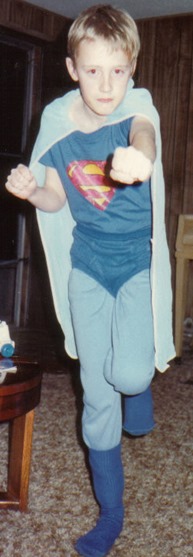
I am a huge Superman fan. My favorite movie of all time is not a Star Trek film, a Star Wars film, or even a Disney film, it’s 1978’s Superman: The Movie. When I wasn’t pretending to be Captain Kirk as a kid, I was zooming around the house in my makeshift Superman costume with John William’s soundtrack blaring in the background.

superdaveI am totally serious about that

I love Superman. And even though I went through a very brief teenage phase where I thought Spider-Man was cooler because he was angsty and Todd McFarlane drew him, the Death of Superman arc in the early 90s pulled me right back into Superman fandom.

These days I’m not a regular reader of the comics, but my favorite stories include most of Grant Morrison’s work (especially All Star Superman) and Mark Waid’s Kingdom Come and Birthright. You could say I prefer the more classic Superman that has fun, science fiction-y adventures and a strict moral code.

And I liked Man Of Steel.

You’re probably wondering if you read that wrong. How could a guy who loves the colorful, funny, lighthearted 1978 film also like the desaturated, grimmer, more somber 2013 edition? How could a guy who loves the version of Superman whose greatest power is his instinctive knowledge of right and wrong and who’s sworn never to use his power to take a life enjoy a film where the Last Son of Krypton snaps a guy’s neck?

Well, let me go ahead and talk about the Zod Neck Snap since it is the most controversial element of the film. I’m a big believer in the Superman Doesn’t Kill rule. If Superman breaking Zod’s neck was presented as one of those moments where the audience is supposed to cheer, if Superman looked at the camera and tossed off a snarky one-liner after he did it, then I would be very angry indeed, and this post would be all about what idiots the filmmakers are. But that’s not what happened, is it?

The point of the scene was to force Superman into an impossible choice: kill Zod, an act he feels is morally repellent and wrong, or allow Zod kill the family he’s threatening with his heat vision, and possibly thousands, millions or even billions more. (And no, the family couldn’t run away. That’s what I though at first, too, but their path was blocked by rubble) He didn’t have time to think about it or to formulate some kind of alternative. The options were: 1. Kill Zod, or 2. Allow Zod to kill a lot more people. Instead of our hero getting to choose between a right and a wrong, he’s forced into a situation where he has to choose between a wrong and a wrong. That’s good drama right there.  And yet, many critics argue that the writers should have sucked the drama out of the scene by giving Superman some kind of technobabble alternative. To those people, I have three words: Star Trek: Voyager.

Remember Voyager? That horrible, late-90s, “lite” version of Star Trek that is pretty much universally reviled, even among Star Trek fans? A big reason why it’s so hated is that it set up a situation where the characters would allegedly be forced to make hard choices: stuck on a small spaceship seventy years from home with limited supplies, limited fuel, no allies, and the crew divided into opposing Starfleet and Maquis factions-and then completely failed to follow through with any of it. Is that what you wanted to have the writers of this film do? And rest assured, if the writers had given Superman the last-second technobabble alternative the critics seem to want, then people would have just criticized that decision instead and accused the writers of taking the cheap and easy way out.

What it comes down to, I think, is that a lot of people (some of whom work for high-traffic sites like io9) decided to dislike Man of Steel before anything at all was known about it. And because, like any film, it has a few plot holes and imperfections, as well as some genuinely controversial story points, these things are being used as “evidence” of how bad it is by people who already decided to hate it ahead of time.

The fact is that Superman’s killing of Zod was not glorified. It was not presented as a happy, triumphant moment. It was an agonizing decision that obviously cost Superman dearly. The people who are saying things like “Man of Steel gives us a Superman who won’t hesitate to kill when he thinks it’s necessary” either haven’t seen the movie or are deliberately misinterpreting it to bolster the decision they made to dislike it in advance.

However, all of that being said there is one criticism I have of the scene, and it’s that little kids were subjected to it. The showing I went to had lots of parents with their kids, many of them 10 or under, and it’s a shame they had to see that. If for no other reason than that, I really wish the filmmakers had found another way out. Even though it would have robbed the film of some drama, even if it would have given Superman an “easy out” and allowed him to sidestep having to make a tough dramatic choice, I think that might have been preferable to subjecting kids to a scene where a man’s neck gets broken.

Moving on, although my opinions of the film differ greatly from the conventional Internet opinion of it, there’s one other criticism of the movie that I do agree with: the huge amount of destruction and the ignoring of the huge amount of civilian casualties that must have occurred. However, the problem as I see it is not that Superman fails to show concern for civilians caught in the crossfire of his superhero fight, it’s that the movie kind of forgets that these civilians even exist. Aside from a few shots of people running away from the destruction, civilians are only present when the film needs them to create peril or drama, like when Perry and Steve are trying to rescue Jenny, or when Superman is forced to kill Zod to save the family he’s threatening. In the scenes where Superman and Zod are punching each other through buildings, those buildings appear to be empty. I don’t think that was a writing decision, I think the production just didn’t want to go to the trouble to animate people diving out of the way in those shots. Overall, it goes a long way toward making Metropolis feel less like a real place and more like the final level of a Superman video game.

I’ve read some very thoughtful criticism saying it would have been nice if more drama in the Zod fight could have come from Superman desperately trying to save civilians and fight Zod at the same time, and I totally agree with it. I really believe that Warner Bros. was stung by the complaints that Superman Returns didn’t have any fighting in it and made this film a Superhero Punching Fest to compensate.

I also believe lazy writing is responsible for how life in Metropolis seems to have gone back to normal when Clark Kent comes to work at the Daily Planet, even though it seems that only few weeks or maybe months have passed. After 9/11, a sort of pall hung over New York for weeks, if not months. The disaster in Metropolis was a lot bigger; how can life have gone back to normal there when there’s a 10-mile-wide crater in the middle if the city? Obviously, having spent over two hours telling this origin story, the movie wants to wrap everything up in a nice pretty bow in the last five minutes. It’s a lot like the end of J.J. Abrams’ first Star Trek film, where Kirk is directly promoted from Cadet to Captain at the end of the movie just so it can end with him in command of the Enterprise, since that’s the familiar status quo. Since the people behind Man of Steel made a big deal about how realistic it was going to be, it would have been nice if that realism could have extended to how a city would realistically react to being half-leveled by superpowered aliens and their Evil Death Machine. But the way I see it, this isn’t a problem just with this film but with these kinds of “origin story” movies in general.

So, now that I’ve defended Man of Steel against some of the criticisms leveled against it we arrive back at the question I asked several paragraphs ago: how can a guy who loves the Christopher Reeve films and the more idealistic portrayals of Superman in the comics also like Man of Steel? Well, just because I love some of the more fantastical takes on Superman doesn’t mean I can’t also appreciate a more “realistic” interpretation of the character.

I like to see Superman’s powers visualized with modern special effects. I also appreciate how they’re consistently portrayed and don’t vary according to the needs of the plot. For example, in the 1978 film he can fly fast enough to reverse time, but not stop two missiles. And in Superman Returns, he flies right into Luthor’s Kryptonite island trap without using his vision powers to check the place out first and discover that it’s made of Kryptonite and maybe he shouldn’t land on it. If there’s any of that in Man of Steel I didn’t see it.

The acting in the film is top-notch. Henry Cavill is great. Amy Adams is the best Lois Lane we’ve ever had. Michael Shannon is an excellent Zod, with a more logical reason for his actions beyond the “cartoon villain” motivations Terence Stamp had to work with in the Donner films. I love the little story arc Christopher Meloni’s character has, and I thought Laurence Fishburne made a fantastic Perry White. I couldn’t believe the some of the negative reactions I saw when he was first cast in the role, all based around the fact that he’s African-American, and not white like all previous versions of the character. Who cares? You should get the best actors you can, and if an actor of Fishburne’s caliber is available you had darned well better cast him!

Most of all, I appreciated the film’s trying to realistically portray how people would react to the presence of someone like Superman. In the previous films  and TV shows, we’ve never seen that. Especially in the 1978 film, everyone seems just pleased as punch about the flying bulletproof space alien, and not the least bit freaked out. In some of the more recent comic book reboots of Superman’s origin, he’s been distrusted by the military at first, but as soon as he does a few good deeds that distrust is quickly forgotten (I’m thinking of Birthright and Geoff Johns’ Secret Origin here. The New 52 handles it a little better). Staying on the realism theme, I also appreciate how Lois Lane is in on Clark’s secret from the beginning, ensuring that we won’t be asked to believe than an award-winning investigative reporter can be fooled by a pair of glasses. Still, in the brief scene we saw with Clark in the glasses it didn’t look like he was putting forth any effort to try to act like a different person. It reminded me of Dean Cain’s Clark, and not in a good way. Hopefully the dual identity thing will get a believability injection in the sequel.

The fact that I enjoyed Man of Steel doesn’t mean I think everyone who didn’t is somehow wrong or not entitled to their opinion. There are several people whose opinions I respect (Mark Waid, for example) who didn’t like the movie and gave very thoughtful reasons why. And that’s fine. My only problem is with the common Internet tendency to try to appear smarter than everyone else by preemptively declaring that a piece of popular entertainment is not any good.

So those are my thoughts on Man of Steel. If you’ve read this far, then you probably deserve some kind of medal. Or maybe you just have too much spare time.

Thursday, September 6, 2012

The Reality Rule

Last week when the five-year-old Cars Land-in-Florida rumor was resurrected by the Great Internet Speculatron, I got to thinking about the nature of reality.

I realize that sentence may raise some questions, like what does Cars Land have to do with the nature of reality? Also, what kind of chemicals are in the water where I am? So let me explain. For the last few years those of us who care about such things had resigned ourselves to the fact that there would be no Cars Land in Florida anytime soon, if ever, and that Disney’s Hollywood Studios would remain pretty much the same for the foreseeable future.

And then somebody on a message board who is generally believed to have inside information said that Disney was bringing Cars Land to Hollywood Studios. Some people loved the idea and some hated it, but for both groups Cars Land at the Studios was real. They were already picturing themselves walking down the Streets of America and seeing off in the distance a Radiator Springs Racers sign and those angled rocks from where Captain Kirk fought the Gorn.

KirkGornThe only difference is that the Cars Land rocks are more orange


And as things began to cool down with more rumors that maybe John Lasseter was against the idea and the realization that Disney’s thick-headed Orlando executives would rather surgically remove their own spleens than spend money on anything that’s not a DVC resort, plus the simple fact that even if Cars Land was approved it’d be several years before it opened, the orangey-colored rocks and Route 66 trappings began to fade from our mental picture of the end of the Streets of America. The Lights, Motors, Action stadium stood there again, just as it always had in reality.

This whole thing reminds me of the early years of EPCOT Center, and the excitement surrounding the World Showcase's most prominent "coming attraction", the Equatorial Africa pavilion. The definitive EPCOT Center tome, Richard Beard’s Walt Disney’s EPCOT: Creating The New World of Tomorrow, devoted a whole chapter to it, with a fairly detailed breakdown of the shows and experiences the pavilion would offer. Equatorial Africa was prominently featured as a coming EPCOT attraction in the park’s early years. Alex Haley even appeared on the EPCOT Center opening-day TV special in 1982 to talk about it, and his segment ended with him and Danny Kaye promising to visit the new pavilion together.

My point is that for a couple years there in the early 1980s, the Equatorial Africa pavilion was real. Buildings had been designed, shows had been written, concept art had been widely released, and there was a big sign on the expansion plot between China and Germany promising that Equatorial Africa was coming soon. How many people stopped and imagined that, on their next trip to Florida, the African pavilion would occupy that empty space?  And you can be sure that if today’s Internet had existed then, there would have been long debates about the new pavilion: whether it had too many attractions or not enough attractions or whether there should be a Mount Kilimanjaro coaster or flume ride to give the area some thrills. But all of those announcements, promises, imaginings and pieces of concept art were rendered moot when Equatorial Africa was cancelled and we were forced to face the fact that it was never real at all.

Over the years, Disney has announced a lot more projects that never advanced past the concept art stage: things like WESTCot, Port Disney, and Disney’s America. Other projects were drastically scaled down: only half the original Animal Kingdom concept actually got built, and the sweeping Project Gemini that would have remade EPCOT’s Future World ended up consisting solely of Soarin’. Perhaps you think this would make Disney fans adopt a “wait and see” attitude about any new rumors or announcements.

Don’t be silly.

The truth is that almost anything, be it an unsubstantiated rumor from someone who claims to have connections or a piece of concept art released on the official Disney Parks blog, is enough to whip the Disney fanbase into a frenzy of fiercely opposing viewpoints. Take Avatar Land, which is slated to open at Animal Kingdom at some point in the current century, unless it doesn’t. All that was announced was that there would be an Avatar Land at Animal Kingdom. That’s all. No concept art, no description of possible attractions, nothing. But that complete lack of data didn’t stop people from taking to the Internet to declare that Avatar Land would either be the best thing since penicillin or the worst thing since Rob Schneider’s career, and accuse the people who disagreed with them as being no better than the cowards who stood by and let Hitler overrun Czechoslovakia.

Now, the Disney fan community isn’t the only one that engages in this ridiculous behavior pattern. Right now there’s a segment of the online Superman fan community who has already decided that it hates the new movie Man of Steel, even though they haven’t seen it yet because it won’t be released until Summer 2013.

So, I’ve made a decision. By the power vested in me as a person who says things on the Internet, I hereby declare Kiri-kin-tha’s First Law of Metaphysics to be in effect online:

Nothing unreal exists, and no arguments about nonexistent things are allowed.

So, a Florida Cars Land? It doesn’t exist right now. It’s not real. So stop arguing about it. Avatar Land? It’s even less real than the Floridian Cars Land. No arguing about that either. If either of these projects actually gets off the ground and are actually built and opened, then they will be real and you can argue about them.

Okay, I’m going to get off my soapbox now. Later I’ll be back with a post about EPCOT’s logo, and as the 25th anniversary of Star Trek: The Next Generation gets closer I’ll have something about that.

Happy Internetting!

Tuesday, June 14, 2011

Rebooting Superman

As long as I can remember, my three favorite things have always been (in no particular order) Star Trek, Disney World, and Superman. This blog is mainly about Disney World, and I’ve written about Star Trek from time to time, but this is the first time I’ve been compelled to write about Superman. The reason, as you might have guessed, is the recently-announced Giant Reboot Of The Whole DC Comics Universe.

There’s a lot we don’t know at this point, but it seems that Superman will get the most drastic changes, with a new origin and even a new costume:

superman1Okay, why does he need a belt if he no longer has the red undershorts?

So what’s the reason for all this? After all, this will be the third new origin Superman has been given since 2003. Well, since the reboot is being coupled with a new digital distribution scheme it’s obvious that DC is trying to create a jumping-on point for new readers. Unfortunately, there may be an even more nefarious reason for the big changes coming to Superman: lawyers.

You see, a court has ruled that the rights to the Superman’s first appearance in 1938’s Action Comics #1 should revert to the family of co-creator Jerry Siegel. I’m no expert in coypright law, but based on what I’ve read elsewhere this means that the Siegels now own all the elements of the Superman mythos that appeared in that seminal issue. This would include his classic costume, his Kryptonian orgin, his power of invulnerability, and Clark Kent’s job as a newspaper reporter with a gruff editor and a co-worker named Lois. The theory in most Superman fan circles is that this new version of Superman has been designed to excise those things. This amounts to having lawyers make creative decisions, and that’s a very bad thing.

There are already Superman-like characters that are designed to be similar to him, yet different enough to avoid claims of copyright infringement. It doesn’t matter if DC still has the right to publish comics about a character named Superman who wears the S-shield on his chest, if he’s missing half of the Superman mythos then he might as well be Mr. Majestic, Samaritan, Supreme, or any of the other knock-off characters we’ve seen over the years.

The worst-case scenario here is that Warner Brothers (DC’s parent company) and the Siegels will be unable to come to terms, and that both parties will market their own versions of Superman using the pieces of the character that they each own. This would obviously be a disaster. Hopefully, both sides realize this and reach some kind of a settlement.

The only reason I have for optimism here is that Grant Morrison, author of All-Star Superman, the most perfect Superman story ever, is involved with the reboot and will be writing Action Comics. My hope is that the “new” Superman will end up a lot like the proposed Superman 2000 revamp that Morrison, Mark Waid, and Mark Millar proposed back in the late ‘90s.

Still, if Warner Brothers and the Siegel family can’t come to some kind of an agreement over the copyright issue, then not even Grant Morrison will be able to save Superman. And that would be a shame.